via centerforhealthsecurity
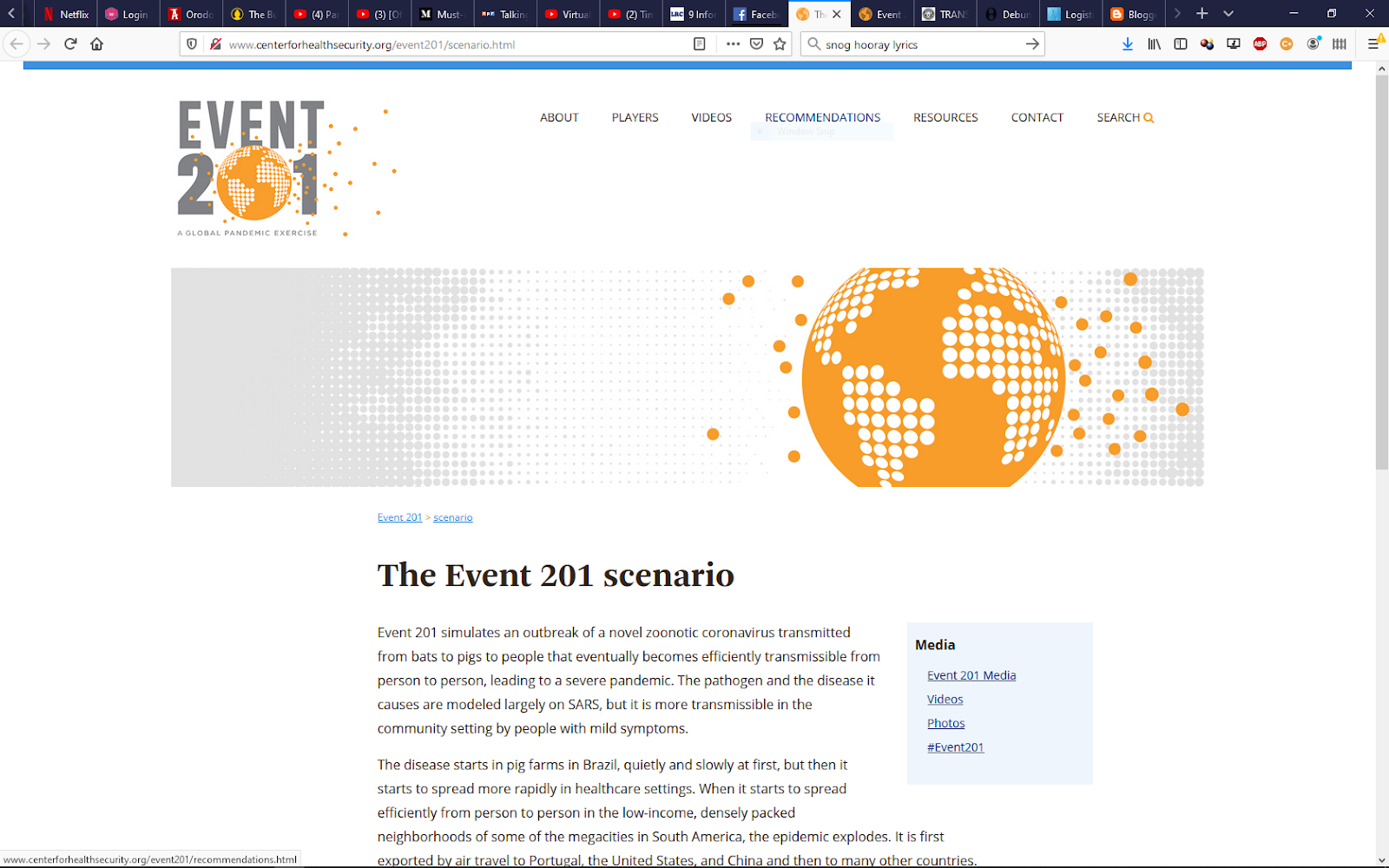
Event 201 simulates an outbreak of a novel zoonotic coronavirus transmitted from bats to pigs to people that eventually becomes efficiently transmissible from person to person, leading to a severe pandemic. The pathogen and the disease it causes are modeled largely on SARS, but it is more transmissible in the community setting by people with mild symptoms.
The disease starts in pig farms in Brazil, quietly and slowly at first, but then it starts to spread more rapidly in healthcare settings. When it starts to spread efficiently from person to person in the low-income, densely packed neighborhoods of some of the megacities in South America, the epidemic explodes. It is first exported by air travel to Portugal, the United States, and China and then to many other countries. Although at first some countries are able to control it, it continues to spread and be reintroduced, and eventually no country can maintain control.
There is no possibility of a vaccine being available in the first year. There is a fictional antiviral drug that can help the sick but not significantly limit spread of the disease.
Since the whole human population is susceptible, during the initial months of the pandemic, the cumulative number of cases increases exponentially, doubling every week. And as the cases and deaths accumulate, the economic and societal consequences become increasingly severe.
The scenario ends at the 18-month point, with 65 million deaths. The pandemic is beginning to slow due to the decreasing number of susceptible people. The pandemic will continue at some rate until there is an effective vaccine or until 80-90 % of the global population has been exposed. From that point on, it is likely to be an endemic childhood disease.
Showing posts with label pandemic. Show all posts
Saturday, March 21, 2020
Event 201
Labels:
Bill Gates,
china,
coronavirus,
event 201,
Melinda,
pandemic,
SARS
Canada Investigates China’s Biological Espionage
By
GreatGameIndia -
August 8, 2019 | Last modified on February 29th, 2020 at 9:55 pm,
Canada has launched an investigation into China’s Biological Espionage. Bio-warfare experts question why Canada was sending lethal viruses to China.
In a table-top pandemic exercise at Johns Hopkins University last year, a pathogen based on the emerging Nipah virus was released by fictional extremists, killing 150 million people.
A less apocalyptic scenario mapped out by a blue-ribbon U.S. panel envisioned Nipah being dispersed by terrorists and claiming over 6,000 American lives.
Scientists from Canada’s National Microbiology Laboratory (NML) have also said the highly lethal bug is a potential bio-weapon.
But this March that same lab shipped samples of the henipavirus family and of Ebola to China, which has long been suspected of running a secretive biological warfare program.
China strongly denies it makes germ weapons, and Canadian officials say the shipment was part of its efforts to support public-health research worldwide. Sharing of such samples internationally is relatively standard practice.
But some experts are raising questions about the March transfer, which appears to be at the centre of a shadowy RCMP investigation and dismissal of a top scientist at the Winnipeg-based NML.
“I would say this Canadian ‘contribution’ might likely be counterproductive,” said Dany Shoham, a biological and chemical warfare expert at Israel’s Bar-Ilan University. “I think the Chinese activities … are highly suspicious, in terms of exploring (at least) those viruses as BW agents. “
James Giordano, a neurology professor at Georgetown University and senior fellow in biowarfare at the U.S. Special Operations Command, said it’s worrisome on a few fronts.
China’s growing investment in bio-science, looser ethics around gene-editing and other cutting-edge technology and integration between government and academia raise the spectre of such pathogens being weaponized, he said.
That could mean an offensive agent, or a modified germ let loose by proxies, for which only China has the treatment or vaccine, said Giordano, co-head of Georgetown’s Brain Science and Global Law and Policy Program.
“This is not warfare, per se,” he said. “But what it’s doing is leveraging the capability to act as global saviour, which then creates various levels of macro and micro economic and bio-power dependencies.”
Asked if the possibility of the Canadian germs being diverted into a Chinese bio weapons program is connected to other upheaval at the microbiology lab, Public Health Agency of Canada spokeswoman Anna Maddison said this week the agency “continues to look into the administrative matter.”
The agency divulged last week that it sent samples of Ebola and henipavirus — which includes Nipah and the related Hendra — to China in March. It was meant for virus research, part of the agency’s mission to back international public-health research, a spokesman said.
Last month, an acclaimed NML scientist — Xiangguo Qiu — was reportedly escorted out of the lab along with her husband, another biologist, and members of her research team. The agency said it was investigating an “administrative issue,” and had referred a possible policy breach to the RCMP. Little more has been said about the affair.
China has been a signatory to the Biological Weapons Convention since 1984, and has repeatedly insisted it is abiding by the treaty that bans developing bio-weapons.
But suspicions have persisted, with the U.S. State Department and other agencies stating publicly as recently as 2009 that they believe China has offensive biological agents.
Though no details have appeared in the open literature, China is “commonly considered to have an active biological warfare program,” says the Federation of American Scientists. An official with the U.S. Army Medical Research Institute of Chemical Defence charged last month China is the world leader in toxin “threats.”
In a 2015 academic paper, Shoham – of Bar-Ilan’s Begin-Sadat Center for Strategic Studies – asserts that more than 40 Chinese facilities are involved in bio-weapon production.
China’s Academy of Military Medical Sciences actually developed an Ebola drug – called JK-05 — but little has been divulged about it or the defence facility’s possession of the virus, prompting speculation its Ebola cells are part of China’s bio-warfare arsenal, Shoham told the National Post.
Ebola is classified as a “category A” bioterrorism agent by the U.S. Centers for Disease Control and Prevention, meaning it could be easily transmitted from person to person, would result in high death rates and “might cause panic.” The CDC lists Nipah as a category C substance, a deadly emerging pathogen that could be engineered for mass dissemination.
Nipah, which was first seen in Malaysia in 1998, has caused a series of outbreaks across east and south Asia, with death rates mostly over 50 per cent, and as high as 100 per cent, according to World Health Organization figures. It can cause encephalitis, an often-fatal brain swelling, and has no known treatment or vaccine.
The Johns Hopkins exercise — called Clade X — involved a version of Nipah modified to be more easily passed between people. America’s Blue Ribbon Study Panel on Biodefence prefaced its 2015 report with a scenario involving the intentional release of Nipah by aerosol spray.
China’s extensive and controversial use of CRISPR gene-editing and weaponizing Biotechnology makes it conceivable the country could bio-engineer germs like Nipah to make them even more dangerous, Giordano said.
GreatGameIndia -
August 8, 2019 | Last modified on February 29th, 2020 at 9:55 pm,
Canada has launched an investigation into China’s Biological Espionage. Bio-warfare experts question why Canada was sending lethal viruses to China.
In a table-top pandemic exercise at Johns Hopkins University last year, a pathogen based on the emerging Nipah virus was released by fictional extremists, killing 150 million people.
A less apocalyptic scenario mapped out by a blue-ribbon U.S. panel envisioned Nipah being dispersed by terrorists and claiming over 6,000 American lives.
Scientists from Canada’s National Microbiology Laboratory (NML) have also said the highly lethal bug is a potential bio-weapon.
But this March that same lab shipped samples of the henipavirus family and of Ebola to China, which has long been suspected of running a secretive biological warfare program.
China strongly denies it makes germ weapons, and Canadian officials say the shipment was part of its efforts to support public-health research worldwide. Sharing of such samples internationally is relatively standard practice.
But some experts are raising questions about the March transfer, which appears to be at the centre of a shadowy RCMP investigation and dismissal of a top scientist at the Winnipeg-based NML.
“I would say this Canadian ‘contribution’ might likely be counterproductive,” said Dany Shoham, a biological and chemical warfare expert at Israel’s Bar-Ilan University. “I think the Chinese activities … are highly suspicious, in terms of exploring (at least) those viruses as BW agents. “
James Giordano, a neurology professor at Georgetown University and senior fellow in biowarfare at the U.S. Special Operations Command, said it’s worrisome on a few fronts.
China’s growing investment in bio-science, looser ethics around gene-editing and other cutting-edge technology and integration between government and academia raise the spectre of such pathogens being weaponized, he said.
That could mean an offensive agent, or a modified germ let loose by proxies, for which only China has the treatment or vaccine, said Giordano, co-head of Georgetown’s Brain Science and Global Law and Policy Program.
“This is not warfare, per se,” he said. “But what it’s doing is leveraging the capability to act as global saviour, which then creates various levels of macro and micro economic and bio-power dependencies.”
Asked if the possibility of the Canadian germs being diverted into a Chinese bio weapons program is connected to other upheaval at the microbiology lab, Public Health Agency of Canada spokeswoman Anna Maddison said this week the agency “continues to look into the administrative matter.”
The agency divulged last week that it sent samples of Ebola and henipavirus — which includes Nipah and the related Hendra — to China in March. It was meant for virus research, part of the agency’s mission to back international public-health research, a spokesman said.
Last month, an acclaimed NML scientist — Xiangguo Qiu — was reportedly escorted out of the lab along with her husband, another biologist, and members of her research team. The agency said it was investigating an “administrative issue,” and had referred a possible policy breach to the RCMP. Little more has been said about the affair.
China has been a signatory to the Biological Weapons Convention since 1984, and has repeatedly insisted it is abiding by the treaty that bans developing bio-weapons.
But suspicions have persisted, with the U.S. State Department and other agencies stating publicly as recently as 2009 that they believe China has offensive biological agents.
Though no details have appeared in the open literature, China is “commonly considered to have an active biological warfare program,” says the Federation of American Scientists. An official with the U.S. Army Medical Research Institute of Chemical Defence charged last month China is the world leader in toxin “threats.”
In a 2015 academic paper, Shoham – of Bar-Ilan’s Begin-Sadat Center for Strategic Studies – asserts that more than 40 Chinese facilities are involved in bio-weapon production.
China’s Academy of Military Medical Sciences actually developed an Ebola drug – called JK-05 — but little has been divulged about it or the defence facility’s possession of the virus, prompting speculation its Ebola cells are part of China’s bio-warfare arsenal, Shoham told the National Post.
Ebola is classified as a “category A” bioterrorism agent by the U.S. Centers for Disease Control and Prevention, meaning it could be easily transmitted from person to person, would result in high death rates and “might cause panic.” The CDC lists Nipah as a category C substance, a deadly emerging pathogen that could be engineered for mass dissemination.
Nipah, which was first seen in Malaysia in 1998, has caused a series of outbreaks across east and south Asia, with death rates mostly over 50 per cent, and as high as 100 per cent, according to World Health Organization figures. It can cause encephalitis, an often-fatal brain swelling, and has no known treatment or vaccine.
The Johns Hopkins exercise — called Clade X — involved a version of Nipah modified to be more easily passed between people. America’s Blue Ribbon Study Panel on Biodefence prefaced its 2015 report with a scenario involving the intentional release of Nipah by aerosol spray.
China’s extensive and controversial use of CRISPR gene-editing and weaponizing Biotechnology makes it conceivable the country could bio-engineer germs like Nipah to make them even more dangerous, Giordano said.
Subscribe to:
Posts (Atom)