Showing posts with label tao. Show all posts

Tuesday, October 17, 2017

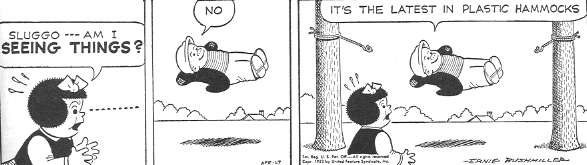
Alan Watts Explains the Meaning of the Tao, with the Help of the Greatest Nancy Panel Ever Drawn


A Nancy panel is an irreducible concept, an atom, and the comic strip is a molecule. - comics theorist Scott McCloud
A little over ten years ago, cartoonist Jim Woodring isolated a single image from Ernie Bushmiller’s long-running and deeply polarizing Nancy comic strip, celebrating it on his blog, the Woodring Monitor, as "the greatest Nancy panel ever drawn.”

What makes this panel the greatest? Woodring declined to elaborate, though his readers eagerly shared theories—and some befuddlement—in the comments section:
Sluggo has reached the perfect state of no-effort, the satori-like denial of the "small mind" and all of the suffering that comes with it.
… it's the comic equivalent of a koan—something designed to tie our rational mind in knots so that we can glimpse enlightenment.

Sluggo smiles because he knows a secret. He says no because he rejects consensus reality. He floats along because he doesn’t fight life—he sees the maintenance of the harmony and is one with that harmony. He knows all paths lead away from home. Instead he goes within and knows freedom.

"I am content. I need nothing, I will do nothing, I am fine as I am.”

Another fan, Glyph Jockey’s Lex 10, took it one step further, removing the speech bubble before taking Sluggo on an animated trip through the cosmos, narrated by philosopher Alan Watts:

In the state of being in accordance with the Tao, there is a certain feeling of weightlessness, parallel to the weightlessness that people feel when they get into outer space or when they go deep into the ocean.
 
Gabby Pahinui's “Pu’uanahulu” and Ramayana imagery bestow added hypnotic appeal.

Revisit this strange little animated gem the next time your head's about to explode from stress. Don’t question or get too hung up on meanings, just go with the flow, like Sluggo and Watts.

Could other Nancy panels serve as vehicles for Taoist enlightenment? Mayhaps:
Bushmiller’s strong point was never the content of his comic strip's jokey plots—a friend once described him as 'a moron on an acid trip.' In fact, the gags were even simpler than was necessary for a 'children's' strip. That's because they were just a vehicle for the controlled and brilliant manipulation of repetition and variety that gave the strip its unique visual rhythm and composition. Bushmiller choreographed his familiar formal elements inside the tightest frame of any major strip, and that helped make it the most beautiful, as a whole, of any in the papers.” - Tom Smucker, The Village Voice, 1982

Recently, Bushmiller’s Nancy has been enjoying a renaissance. The strip that many casual readers of the funny pages dismissed as boring or dumb is revered by many celebrated cartoonists, including Bill Griffith, Daniel Clowes, and Art Spiegelman.

This month sees the publication of Paul Karasik and Mark Newgarden’s How to Read Nancy, a book length analysis of one single strip, which also functions as a how-to and history of the comic medium. This hotly anticipated volume has in turn given rise to a lively online How To Read Nancy Reading Group, a hotbed of fan art, altered panels, and Nancy strips from around the world.

Invite your pals over to play comic theorist Scott McCloud’s Dadaist game Five Card Nancy or take the online version for a solo spin.

And for those who require context, here is the original strip from which the floating Sluggo panel is drawn.

Apparently the key to the Tao is a plastic hammock…


Monday, July 4, 2016

The Taoist Way - Alan Watts


“Life is a series of natural and spontaneous changes. Don't resist them; that only creates sorrow. Let reality be reality. Let things flow naturally forward in whatever way they like.” - Lao Tzu

Tuesday, November 3, 2015

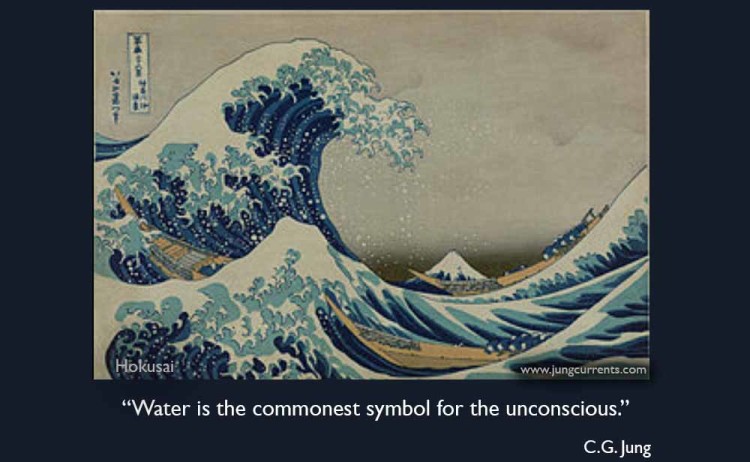
The symbolism of water - Carl Jung

via jungcurrents


Water is the commonest symbol for the unconscious.

The lake in the valley is the unconscious, which lies, as it were, underneath consciousness, so that it is often referred to as the “subconscious,” usually with the pejorative connotation of an inferior consciousness.

Water is the “valley spirit,” the water dragon of Tao, whose nature resembles water- a yang in the yin, therefore, water means spirit that has become unconscious.

Archetypes of the Collective Unconscious

Paragraph 40

Saturday, August 1, 2015

The Taoist View of the Universe – Alan Watts

via Creative by Nature:

Taoists view the universe as the same as, or inseparable from, themselves so that Lao-tzu could say, “Without leaving my house, I know the whole universe.” This implies that the art of life is more like navigation than warfare, for what is important is to understand the winds, the tides, the currents, the seasons, and the principles of growth and decay, so that one’s actions may use them and not fight them.” ~Alan Watts

“At the very roots of Chinese thinking and feeling there lies the principle of polarity, which is not to be confused with the ideas of opposition or conflict. In the metaphors of other cultures, light is at war with darkness, life with death, good with evil, and the positive with the negative, and thus an idealism to cultivate the former and be rid of the latter flourishes throughout much of the world.

To the traditional way of Chinese thinking this is as incomprehensible as an electric current without both positive and negative poles, for polarity is the principle that plus and minus, north and south, are different aspects of one and the same system, and that the disappearance of either one of them would be the disappearance of the system.

People who have been brought up in the aura of Christian and Hebrew aspirations find this frustrating, because it seems to deny any possibility of progress, an ideal which flows from their linear (as distinct from cyclic) view of time and history. Indeed, the whole enterprise of Western technology is “to make the world a better place” – to have pleasure without pain, wealth without poverty, and health without sickness.

But, as is now becoming obvious, our violent efforts to achieve this ideal with such weapons as DDT, penicillin, nuclear energy, automotive transportation, computers, industrial farming, damming, and compelling everyone, by law, to be superficially “good and healthy” are creating more problems than they solve.

We have been interfering with a complex system of relationships which we do not understand, and the more we study its details, the more it eludes us by revealing still more details to study. As we try to comprehend and control the world it runs away – from us. Instead of chafing at this situation, a Taoist would ask what it means. What is that which always retreats when pursued? Answer: yourself.

Idealists (in the moral sense of the word) regard the universe as different and separate from themselves- that is, as a system of external objects which needs to be subjugated. Taoists view the universe as the same as, or inseparable from, themselves so that Lao-tzu could say, “Without leaving my house, I know the whole universe.”

This implies that the art of life is more like navigation than warfare, for what is important is to understand the winds, the tides, the currents, the seasons, and the principles of growth and decay, so that one’s actions may use them and not fight them.

In this sense, the Taoist attitude is not opposed to technology per se. Indeed, the Chuang-tzu writings are full of references to crafts and skills perfected by this very principle of “going with the grain.” The point is therefore that technology is destructive only in the hands of people who do not realize that they are one and the same process as the universe.

Our overspecialization in conscious attention and linear thinking has led to neglect, or ignore-ance, of the basic principles and rhythms of this process, of which the foremost is polarity.

In Chinese the two poles of cosmic energy are yang (positive) and yin (negative), associated with the masculine and the feminine, the firm and the yielding, the strong and the weak, the light and the dark, the rising and the falling, heaven and earth, and they are even recognized in such everyday matters as cooking as the spicy and the bland.

Thus the art of life is not seen as holding to yang and banishing yin, but as keeping the two in balance, because there cannot be one without the other.

When regarding them as the masculine and the feminine, the reference is not so much to male and female individuals as to characteristics which are dominant in, but not confined to, each of the two sexes. The male individual must not neglect his female component, nor the female her male. Thus Lao-tzu says:

Knowing the male but keeping the female, one becomes a universal stream. Becoming a universal stream, one is not separated from eternal virtue.
The yang and the yin are principles, not men and women, so that there can be no true relationship between the affectedly tough male and the affectedly flimsy female. The key to the relationship between yang and yin is called hsiang sheng, mutual arising or inseparability. As Lao-tzu puts it:

When everyone knows beauty as beautiful,
there is already ugliness;
When everyone knows good as goodness,
there is already evil.

“To be” and “not to be” arise mutually;
Difficult and easy are mutually realized;
Long and short are mutually contrasted;
High and low are mutually posited;
Before and after are in mutual sequence.

They are thus like the different, but inseparable, sides of a coin, the poles of a magnet, or pulse and interval in any vibration. There is never the ultimate possibility that either one will win over the other, for they are more like lovers wrestling than enemies fighting.

It is difficult in our logic to see that being and non-being are mutually generative and mutually supportive, for it is the great and imaginary terror of Western man that nothingness will be the permanent universe. We do not easily grasp the point that the void is creative, and that being comes from non-being as sound from silence and light from space.

Thirty spokes unite at the wheel’s hub;
It is the center hole that makes it useful.
Shape clay into a vessel;
It is the space within that makes it useful.
Cut out doors and windows for a room;
It is the holes which make it useful.
Therefore profit comes from what is there;
Usefulness from what is not there.


This space is not “just nothing” as we commonly use that expression, for I cannot get away from the sense that space and my awareness of the universe are the same, and call to mind the words of the Chan (Zen) Patriarch Hui-neng, writing eleven centuries after Lao-tzu:

The capacity of mind is broad and huge, like the vast sky. Do not sit with a mind fixed on emptiness. If you do you will fall into a neutral kind of emptiness. Emptiness includes the sun, moon, stars, and planets, the great earth, mountains and rivers, all trees and grasses, bad men and good men, bad things and good things, heaven and hell; they are all in the midst of emptiness. The emptiness of human nature is also like this.
Thus the yin-yang principle is that the somethings and the nothings, the ons and the offs, the solids and the spaces, as well as the wakings and the sleepings and the alternations of existing and not existing, are mutually necessary.

Yang and yin are in some ways parallel to the (later) Buddhist view of form and emptiness, of which the Heart Sutra says, “That which is form is just that which is emptiness and that which is emptiness is just that which is form.”

The yin-yang principle is not, therefore, what we would ordinarily call a dualism, but rather an explicit duality expressing an implicit unity.”

-Alan Watts

Wednesday, June 10, 2015

The Tao of politics

“Since I entered politics, I have chiefly had men's views confided to me privately. Some of the biggest men in the United States, in the field of commerce and manufacture, are afraid of something. They know that there is a power somewhere so organized, so subtle, so watchful, so interlocked, so complete, so pervasive, that they better not speak above their breath when they speak in condemnation of it.”

Woodrow Wilson, The New Freedom

“The real truth of the matter is, as you and I know, that a financial element in the larger centers has owned the Government ever since the days of Andrew Jackson.”

Franklin D. Roosevelt, letter to Col. House, November 21, l933

“The powers of financial capitalism had another far-reaching aim, nothing less than to create a world system of financial control in private hands able to dominate the political system of each country and the economy of the world as a whole.”

Carroll Quigley, Tragedy and Hope: A History of the World in Our Time, 1966

“From the days of Spartacus-Weishaupt to those of Karl Marx, to those of Trotsky, Bela Kun, Rosa Luxembourg, and Emma Goldman, this world wide conspiracy for the overthrow of civilization and for the reconstitution of society on the basis of arrested development, of envious malevolence and impossible equality, has been steadily growing. It played a definitely recognizable role in the tragedy of the French Revolution. It has been the mainspring of every subversive movement during the nineteenth century, and now at last this band of extraordinary personalities from the underworld of the great cities of Europe and America have gripped the Russian people by the hair of their heads, and have become practically the undisputed masters of that enormous empire.”

Winston Churchill, 1922

“The Council on Foreign Relations (CFR) is dedicated to one-world government, financed by a number of the largest tax exempt foundation (i.e. Rockefeller), and wielding such power and influence over our lives in the areas of finance, business, labor, military, education, and mass communication media, that it should be familiar to every American concerned with good government and with preserving and defending the US Constitution and our free-enterprise system. Yet, the nation’s right-to-know machinery, the news media; usually so aggressive in exposures to inform our people, remain silent when it comes to the CFR, its members and their activities. The CFR is the establishment. Not only does it have influence and power in key decision-making positions at the highest levels of government to apply pressure from above, but it also finances and uses individuals and groups to bring pressure from below, to justify the high level decisions for converting the US from a sovereign Republic into a servile member of a one-world dictatorship.”

 Rep. John R. Rarick (D-LA)

“The one aim of these financiers is world control by the creation of inextinguishable debts.”

Henry Ford

“Some even believe we are a part of a secret cabal working against the best interests of the United States, characterizing my family and me as ‘internationalists’ and of conspiring with others around the world to build a more integrated global political and economic structure – one world, if you will. If that’s the charge, I stand guilty and I am proud of it.”

David Rockefeller, Memoirs

 “The interests behind the Bush administration, such as the CFR, the Trilateral Commission – founded by Brzezinski for David Rockefeller – and the Bilderberg Group have prepared for and are now moving to implement open world dictatorship within the next five years.”

Dr. Johannes Koeppl, Former German Ministry for Defence official and advisor to NATO

 “The real menace of our republic is this invisible government which like a giant octopus sprawls its slimy length over city, state and nation. Like the octopus of real life, it operates under cover of a self created screen….At the head of this octopus are the Rockefeller Standard Oil interests and a small group of powerful banking houses generally referred to as international bankers. The little coterie of powerful international bankers virtually run the United States government for their own selfish purposes. They practically control both political parties.”

John F. Hylan, NYC Mayor, 1922

 “The governments of the present day have to deal not merely with other governments, with emperors, kings and ministers, but also with the secret societies which have everywhere their unscrupulous agents, and can at the last moment upset all the governments’ plans. “

 “The world is governed by very different personages from what is imagined by those who are not behind the scenes.”

Benjamin Disraeli, first Prime Minister of England, Coningsby, the New Generation

“The real rulers in Washington are invisible, and exercise power from behind the scenes.”

Felix Frankfurter, Supreme Court Justice, 1952

“The government of the Western nations, whether monarchical or republican, had passed into the invisible hands of a plutocracy, international in power and grasp. It was, I venture to suggest, this semioccult power which… pushed the mass of the American people into the cauldron of World War I.”

MajorGeneral J.F.C. Fuller, British military historian, l941

“Fifty men have run America, and that’s a high figure.”

Joseph Kennedy, The New York Times, July 26th, l936

“It bends governments to its will sometimes by promises, sometimes by threats. It has found its way into every class of Society, and forms an invisible and irresponsible power, an independent government, as it were, within the body corporate of the lawful state.”

Pope Leo XIII, 1902

“Three hundred men, all of-whom know one another, direct the economic destiny of Europe and choose their successors from among themselves.”

Walter Rathenau, head of German General Electric, 1909. Rathenau was Prime Minister of Germany until he was assassinated in 1922.

“There does exist, and has existed for a generation, an international Anglophile network which operates, to some extent, in the way the radical Right believes the Communists act. In fact, this network, which we may identify as the Round Table Groups, has no aversion to cooperating with the Communists, or any other groups, and frequently does so. I know of the operations of this network because I have studied it for twenty years and was permitted for two years, in the early 1960’s, to examine its papers and secret records. I have no aversion to it or to most of its aims and have, for much of my life, been close to it and to many of its  instruments…my chief difference of opinion is that it wishes to remain unknown, and I believe its role in history is significant enough to be known…because the American branch of this organisation (sometimes called the “Eastern Establishment”) has played a very significant role in the history of the United States in the last generation.”

Dr. Carroll Quigley, a professor of history at the Foreign Service School of Georgetown University. Dr. Quigley was Bill Clinton’s mentor while he was at Georgetown University.


Tuesday, March 24, 2015

Fritjof Capra - Bootstrap physics

by Fritjof Capra

In the last two chapters of my book The Tao of Physics, I discussed a theory known as “bootstrap theory,” which was very popular in the 1970s, and on which I worked myself during my ten years at the Lawrence Berkeley Laboratory. This theory, proposed by Geoffrey Chew, is based on the idea that nature cannot be reduced to fundamental entities, like fundamental constituents of matter, but has to be understood entirely through self-consistency. All of physics has to follow uniquely from the requirement that its components be consistent with one another and with themselves.

This idea constitutes a radical departure from the traditional spirit of basic research in physics, which has always concentrated on finding the fundamental constituents of matter. At the same time, it can be seen as the culmination of the conception of particles as interconnections in an inseparable cosmic web, which arose in quantum theory and acquired an intrinsically dynamic nature in relativity theory.

The bootstrap philosophy abandons not only the idea of fundamental constituents of matter but accepts no fundamental entities whatsoever — no fundamental laws or equations, and not even a fundamental structure of space-time. The universe is seen as a dynamic web of interrelated events. None of the properties of any part of this web are fundamental; they all follow from the properties of the other parts, and the overall consistency of their mutual interrelations determines the structure of the entire web.

During the 1980s and 1990s, the bootstrap theory was eclipsed by the success of the standard model, which is very different, as it postulates the existence of fundamental fields and their corresponding particles. And today, bootstrap physics has virtually disappeared from the scene. However, if a theory of quantum gravity continues to remain elusive, and if the a priori assumption of the structure of space-time is broadly recognized as the essential flaw of string theory, the bootstrap idea may well will be revived someday, in some mathematical formulation or other.

Read the entire essay herehttp://www.fritjofcapra.net/the-unification-of-physics/