Maybe you shouldn’t blindly believe everything you read? Even if the source has a pretty solid reputation?
Nature magazine has censored over 1,000 articles at the request of the Chinese government over the past several years. And it seems pretty clear that their recent article, “The proximal origin of SARS-CoV-2” is just one more example of their influence.
China bought off the head of Harvard’s chemistry department, you don’t think they could buy off run-of-the-mill research scientists scrambling for tenure and funding and publication? It’s absolutely horrific that so many scientists and researchers are taking part in what’s really clearly a disinformation campaign orchestrated by the Chinese Communist Party, and willfully spreading a smokescreen about something that’s already killed thousands and is projected to kill millions more across the planet.
And while the mainstream corporate media mindlessly regurgitates claims from the Chinese government that are falsifiable with the simplest of google searches, allowing the public to be lulled into a false sense of security and complacency, and Reddit rapidly censors and moderates anything that might indicate that this virus leaked from a Chinese lab and so the Chinese government is to blame for this pandemic – sites like ZeroHedge, that have been at the forefront of keeping the lines of investigation open, have been banished from Twitter and marginalized.
Below is a takedown of that article, and the good news is a much more nuanced and honest look at the origins of COVID-19, the Wuhan Strain of coronavirus is just a click away.
Thus, the high-affinity binding of the SARS-CoV-2 spike protein to human ACE2 is most likely the result of natural selection on a human or human-like ACE2 that permits another optimal binding solution to arise. This is strong evidence that SARS-CoV-2 is not the product of purposeful manipulation.
As our report mentions right at the start, scientists passed the H5N1 Bird Flu through a series of ferret hosts until it gained ACE2 affinity and then became incredibly virulent, which is what’s seen with COVID-19 since its affinity to ACE2 is orders of magnitude higher than SARS. That process would leave a genome that appears “natural” and not purposeful as well since it wouldn’t leave a genomic smoking gun and would simply appear to be the result of “natural” selection. However the addition of artificial generations produced by this process of passing through ferrets in the lab would create a lot of genetic distance from any possible relatives – precisely what is seen in COVID-19: it forms its own clade and appears very distant from all other bat coronaviruses. So this is lazy research, they’re either unaware of the Bird Flu study or are willfully ignoring it.
Given the level of genetic variation in the spike, it is likely that SARS-CoV-2-like viruses with partial or full polybasic cleavage sites will be discovered in other species.
This seems like pretty intentional dissimulation. It’s “likely” that other viruses with this cleavage site will be found? What? How likely? 1 in 10? 1 in 10 million? Is it likely that if my aunt grew balls she’d become my uncle? Is it “likely” that a natural intermediate animal vector will be found? Well… likely or not, until it happens it seems incredibly disingenuous to state that “likely” means a damn thing here.
The functional consequence of the polybasic cleavage site in SARS-CoV-2 is unknown, and it will be important to determine its impact on transmissibility and pathogenesis in animal models. Experiments with SARS-CoV have shown that insertion of a furin cleavage site at the S1–S2 junction enhances cell–cell fusion without affecting viral entry14.
This doesn’t seem to address the virus’s provenance at all, but just as an aside it seems like a lot of the viruses with furin cleavage sites engage in ADE, which COVID-19 appears to be doing from a clinical perspective: neurological damage, the second infection is worse, and areas like Wuhan with extended infections have much higher CFRs as infections overlap.
The acquisition of polybasic cleavage sites by HA has also been observed after repeated passage in cell culture or through animals17.
Exactly. Passage through a series of ferret hosts in a lab would have given COVID-19 this distinct cleavage site.
It is improbable that SARS-CoV-2 emerged through laboratory manipulation of a related SARS-CoV-like coronavirus. As noted above, the RBD of SARS-CoV-2 is optimized for binding to human ACE2 with an efficient solution different from those previously predicted7,11.
Yes, again we aren’t arguing that this thing was built nucleotide-by-nucleotide as the perfect bespoke bio-weapon. This efficient solution is exactly the kind of thing that would be selected for after passage through ferrets in lab, which was already done to the Bird Flu that created a horrifically virulent strain. Isn’t it funny that no one’s mentioning that experiment? Or Baric’s work at UNC? How come every single public-facing virologist seems to be leaving these studies out? Are they really unaware of them? That seems exceedingly hard to believe when I was able to find them on the front page of a single google search. Seems a lot more likely everyone’s just covering each other’s asses since they realize the magnitude of what’s happening and how deep into the cover-up they already are.
Furthermore, if genetic manipulation had been performed, one of the several reverse-genetic systems available for betacoronaviruses would probably have been used19
This is an utterly vacuous statement. Probably doesn’t mean a damn thing in science. “Okay folks, we probably won’t get an earthquake anytime soon, so no reason to prepare for one or try and detect one coming!” Seriously?
Instead, we propose two scenarios that can plausibly explain the origin of SARS-CoV-2: (i) natural selection in an animal host before zoonotic transfer; and (ii) natural selection in humans following zoonotic transfer.
As we’ve explained before, there was no trace of this virus before November 2019, and full zoonotic jumps don’t just magically happen, especially not of a virus that’s so incredibly adapted to humans and able to infect us undetected and spread undetected, and then kill us after more than enough time has passed to find multiple new hosts. It’s funny so many virologists are throwing out the book of how zoonotic jumps happen… all that money in gain-of-function research must be quite blinding. Kind of amazing they don’t matter how many thousands of people are dying. As far as the intermediate animal host goes: It might as well be a unicorn at this point. Until someone finds it, it’s just conjecture.
Malayan pangolins (Manis javanica) illegally imported into Guangdong province contain coronaviruses similar to SARS-CoV-221. Although the RaTG13 bat virus remains the closest to SARS-CoV-2 across the genome1, some pangolin coronaviruses exhibit strong similarity to SARS-CoV-2 in the RBD, including all six key RBD residues21 (Fig. 1). This clearly shows that the SARS-CoV-2 spike protein optimized for binding to human-like ACE2 is the result of natural selection.
The most recent study, covered in our article, that examines the neutral sites that are assumed to best show heritage found that pangolins are “very unlikely” to have served as a host at all. Their assertion that natural natural selection is clearly shown is raw steamy bullshit. Serial passage through ferrets fits the overall big picture far better than this pangolin crap.
For a precursor virus to acquire both the polybasic cleavage site and mutations in the spike protein suitable for binding to human ACE2, an animal host would probably have to have a high population density (to allow natural selection to proceed efficiently) and an ACE2-encoding gene that is similar to the human ortholog.
WAIT WAIT WAIT!! You mean exactly like a bunch of ferrets, which have the same ACE2 receptor as humans, all jammed into a bunch of cages together and then infected over and over again in a lab?! That’s crazy talk!! Other than the fact it was exactly the process used to make the Bird Flu into something that “could make the 1918 pandemic look like a pesky cold.”
It is possible that a progenitor of SARS-CoV-2 jumped into humans, acquiring the genomic features described above through adaptation during undetected human-to-human transmission. Once acquired, these adaptations would enable the pandemic to take off and produce a sufficiently large cluster of cases to trigger the surveillance system that detected it.
Hence, this scenario presumes a period of unrecognized transmission in humans between the initial zoonotic event and the acquisition of the polybasic cleavage site. Sufficient opportunity could have arisen if there had been many prior zoonotic events that produced short chains of human-to-human transmission over an extended period.
Sure this would be plausible… other than the fact that, as we cover in our report, that statistical analysis shows that this thing didn’t hit humans until November of 2019, which this article agrees with. But zoonotic jumps only occur after a genomic trial-and-error process where the virus jumps to one host, spreads to a few new hosts, and then fizzles out. There is absolutely no evidence anywhere of this occurring. Every single data points to this thing hitting humans in November and being immediately adapted and dangerous. There is no trace whatsoever of it creating small clusters of infections and dying out – stating there could have been doesn’t mean it’s been seen. It hasn’t. And as our report covers, this would require sustained interaction with the intermediate host – how does that happen in the middle of a massive modern urban metropolis the size of NYC? And where is this intermediate host anyways? If an intermediate host isn’t needed, is it some magical sleep-flying bat that decided not to hibernate and fight crime in Wuhan when it’s buddies were all hibernating, creating the sustained interactions with humans as it fought for Justice? Because that’s about as plausible as what’s being proposed here.
The presence in pangolins of an RBD very similar to that of SARS-CoV-2 means that we can infer this was also probably in the virus that jumped to humans.
Again, analysis of the neutral sites shows that pangolins were almost certainly not in play.
Furthermore, a hypothetical generation of SARS-CoV-2 by cell culture or animal passage would have required prior isolation of a progenitor virus with very high genetic similarity, which has not been described
This means nothing. There is no open-source shared database of viruses. No one has any idea what viruses are in China’s BSL-4 lab, where they’ve been collecting these viruses for years. As mentioned, one of our persons-of-interest was the very first person to isolate a coronavirus from a bat that uses the ACE2 receptor. He also worked at UNC in Baric’s lab making the hyper-virulent bat coronavirus in 2015.
Subsequent generation of a polybasic cleavage site would have then required repeated passage in cell culture or animals with ACE2 receptors similar to those of humans, but such work has also not previously been described.
The fuck it hasn’t.
Retrospective serological studies could also be informative, and a few such studies have been conducted showing low-level exposures to SARS-CoV-like coronaviruses in certain areas of China26. Further serological studies should be conducted to determine the extent of prior human exposure to SARS-CoV-2.
Beyond the statistical analysis that indicates it only hit humans in November in 2019, is the fact that the version of COVID-19 found in the first few dozen hosts was exactly the same – there aren’t any variants whatsoever, just one version. This is not what would be found with the genomic trial-and-error of a full zoonotic jump, which requires sustained human-to-human transmission as different variants of the virus try and fail to adapt to human biology. Here, only one variant was found in all the initial infected humans, instead of the multiple variants that would be expected. But does fit what would happen if a virus that already had high affinity to the ACE2 receptor, which is the same in human and ferrets, leaked out of a lab. But addressing this point in particular, oh weird, the study they cite from March of 2018 was done mostly on people who live in villages barely a kilometer away from bat caves. A far cry from a massive urban city bout the size of NYC. Oh, and how many of these villagers, who live about a kilometer or less from bat caves, had antibodies indicating exposure to bat coronaviruses? Two-point-seven percent. (There is hand-waving about how long antibodies persist in humans, but I’m pretty sure it’s more than long enough.) That study actually sampled people living in Wuhan too and found… no evidence whatsoever of exposure to “SARS-CoV-like coronaviruses.” So are these peer-reviewers just straight chugging lead paint, or are they on the take too?
The finding of SARS-CoV-like coronaviruses from pangolins with nearly identical RBDs, however, provides a much stronger and more parsimonious explanation of how SARS-CoV-2 acquired these via recombination or mutation1
Again, just demonstrably false.
Get the real story here.
Saturday, March 21, 2020

TRANSCRIPT: Bioweapons Expert Dr. Francis Boyle On Coronavirus
By
GreatGameIndia -
February 5, 2020 | Last modified on March 16th, 2020 at 11:02 pm,
A recent interview with Bioweapons expert Dr. Francis Boyle published by GreatGameIndia and conducted by Geopolitics & Empire, has been exploding across the world the past few days as the truth is emerging on the origins of the Coronavirus Bioweapon.
Francis Boyle is a professor of international law at the University of Illinois College of Law. He drafted the U.S. domestic implementing legislation for the Biological Weapons Convention, known as the Biological Weapons Anti-Terrorism Act of 1989, that was approved unanimously by both Houses of the U.S. Congress and signed into law by President George H.W. Bush.
In the exclusive interview, Dr. Boyle touches upon GreatGameIndia‘s exclusive report Coronavirus Bioweapon – where we reported in detail how Chinese Biowarfare agents working at the Canadian lab in Winnipeg were involved in the smuggling of Coronavirus to Wuhan’s lab from where it is believed to have been leaked.
In this bombshell interview (full transcript below), Boyle talks about:
The bioweapons origins of the coronavirus
How the Deep State deployed anthrax on US soil to whip up publicity about biological weapons and increase funding for bioweapons labs
Why the WHO and CDC are both criminal organizations which are complicit in the covert development of biological weapons
The “death science” industry and why the US government has spent over $100 billion developing self-replicating weapons
Details about the Pirbright Institute and its ties to bioweapons, depopulation, vaccines and coronavirus patents. (It’s partially funded by Bill & Melinda Gates)
Why all BSL-3 and BSL-4 labs in the world should be banned and shut down.
Full transcript
Geopolitics and Empire: Geopolitics & Empire is joined by Dr. Francis Boyle, who is international law professor at the University of Illinois. We’ll be discussing the Wuhan coronavirus and biological warfare. He’s served as counsel to numerous governments such as Bosnia and Herzegovina and the Palestinian authority. He’s represented numerous national international bodies in the areas of human rights, war crimes and genocide, nuclear policy, and biowarfare. He’s written numerous books, one of my favorites being “Destroying Libya and World Order”, which I assigned as mandatory reading material for my own students when I taught at the Monterrey Institute of Technology.
But most important for this interview, he’s written a book called “Biowarfare and Terrorism”, and drafted the US domestic implementing legislation for the biological weapons convention, known as the Biological Weapons Anti-Terrorism Act of 1989 that was approved unanimously by both houses of the US Congress and signed into law by President Bush. Thanks for joining us, Dr. Boyle.
Dr. Francis Boyle: Wow. Thank you so much for having me on and thanks for that kind introduction.
Geopolitics and Empire: Now let’s get to what’s been on the news recently. This coronavirus in Wuhan. There have been some reports recently, there’s a really interesting website called GreatGameIndia that has been reporting on this. They’ve been talking about China, which they say has been complying with biological weapons convention in recent years.
But then there are some people in the US and experts that have been saying that in reality, China isn’t complying with the weapons convention. And I think neither, perhaps the US as well. I’m wondering if China is developing its own biosafety level four lab in Wuhan and elsewhere, as you know, as a type of deterrence. Is it a type of a biological arms race that we have going on?
You told me in an email that you suspect China was developing the coronavirus as a dual use of biowarfare weapons agent. Also, what do you make of reports that Chinese scientists have been stealing research and viruses, including the coronavirus from a Canadian bio lab this past December?
And as well, Chinese nationals have been charged with smuggling vials of biological research to China from the US with the aid of Charles Lieber who was the chair of Harvard’s chemistry department. And he also happens to be in 2011 a strategic scientist at Wuhan University. So, can you tell us what’s going on with this recent outbreak in Wuhan?
Dr. Francis Boyle: Well, that’s a lot of questions. I guess we can take them one at a time, but if you just do a very simple Google search on “Does China have a BSL-4 laboratory?”, Wuhan comes up right away. It’s at the top of the list. That’s all with the moment this type of thing happened I began to do that. So a BSL-4 is the most serious type. And basically BSL-4 labs, we have many of them here in the United States, are used to develop offensive biological warfare weapons with DNA genetic engineering.
So it does seem to me that the Wuhan BSL-4 is the source of the coronavirus. My guess is that they were researching SARS, and they weaponize it further by giving it a gain of function properties, which means it could be more lethal.
Indeed, the latest report now is it’s a 15% fatality rate, which is more than SARS at 83% infection rate. A typical gain of function travels in the air so it could reach out maybe six feet or more from someone emitting a sneeze or a cough. Likewise, this is a specially designated WHO research lab. The WHO was in on it and they knew full well what was going on there.
Yes. It’s also been reported that Chinese scientists stole coronavirus materials from the Canadian lab at Winnipeg. Winnipeg is Canada’s formal center for research, developing, testing, biological warfare weapons. It’s along the lines of Fort Detrick here in the United States of America. I have three degrees from Harvard. It would not surprise me if something was being stolen out of Harvard to turn over to China. I read that report. I don’t know what was in those vials one way or the other.
But the bottom line is I drafted the US domestic implementing legislation for the Biological Weapons Convention that was approved unanimously by both Houses in the United States Congress signed into law by President Bush Sr. that it appears the coronavirus that we’re dealing with here is an offensive biological warfare weapon that leaped out of Wuhan BSL-4. I’m not saying it was done deliberately. But there had been previous reports of problems with that lab and things leaking out of it. I’m afraid that is what we are dealing with today.
Geopolitics and Empire: We’ll be talking about the Wuhan and the coronavirus and China, but can you give us kind of like a bigger context. I know you’ve, previously, in interviews said that since 9/11, you think that the US has spent $100 billion on biological warfare research. We know the Soviet Union, if I’m not mistaken, developed anthrax as a bioweapon. And you’ve also mentioned that UK, France, Israel and China are all involved in biological warfare weapons research.
And something interesting, I believe one or two years ago a Bulgarian journalist and the Russian government shared their concern of the discovery of a US bioweapons lab in the country of Georgia. You’ve commented how in Africa, US has set up bioweapons labs to work on Ebola, which I think is illegal under international law. But they were allowed somehow to put those in Africa. Can you give us like a bigger picture? What’s going on with these different countries and what’s the purpose of this research?
Dr. Francis Boyle: All these BSL-4 labs are by United States, Europe, Russia, China, Israel are all there to research, develop, test biological warfare agents. There’s really no legitimate scientific reason to have BSL-4 labs. That figure I gave $100 billion, that was about 2015 I believe. I had crunched the numbers and came up with that figure the United States since 9/11.
To give you an idea that’s as much in constant dollars as the US spent to develop the Manhattan Project and the atom bomb. So it’s clearly all weapons related. We have well over 13,000 alleged life science scientists involved in research developed testing biological weapons here in the United States. Actually this goes back it even precedes 9/11 2001.
I have another book, The Future of International Law and American Foreign Policy, tracing that all the way back to the Reagan administration under the influence of the neocons and they got very heavily involved in research development testing of biological weapons with DNA genetic engineers. It was because of that I issued my plea in 1985 in a Congressional briefing sponsored by the Council for Responsible Genetics, I’m a lawyer for them. They’re headquartered in Cambridge, Mass. All the MIT, Harvard people are involved in that, the principal ones. And then they asked me to draft the implementing legislation.
The implementing legislation that I drafted was originally designed to stop this type of work. “Death science work”, I call it, “by the United States government”. After 9/11, 2001, it just completely accelerated. My current figure, that last figure a 100 billion. I haven’t had a chance to re-crunch the numbers because I just started classes. But you have to add in about another 5 billion per year.
Basically, this is offensive biological weapons raised by the United States government and with its assistance in Canada and Britain. And so other States, the world have responded accordingly including Russia and China. They were going to set up a whole series of BSL-4 facilities as well. And you know Wuhan was the first. It backfired on them.
Geopolitics and Empire: Would you basically consider what happened and Wuhan and just boil it down to ineptitude or incompetence on the Chinese part?
Dr. Francis Boyle: Well, it’s criminality. It does appear they stole something there from Winnipeg. This activity that they engaged in clearly violates the Biological Weapons Convention. Research development of biological weapons these days is an international crime, the use of it would be. That was criminal.
I’m not saying they deliberately inflicted this on their own people, but it leaked out of there and all these BSL-4 facilities leak. Everyone knows that who studies this. So this was a catastrophe waiting to happen. Unfortunately, it happened. The Chinese government under Xi and his comrades there have been covering this up from the get-go. The first reported case was December 1, so they’d been sitting on this until they couldn’t anymore. And everything they’re telling you is a lie. It’s propaganda.
The WHO still refuses to declare a global health emergency. It said Tedros was over there shaking hands with Xi and smiling and yanking it up. The WHO was in on it. They’ve approved many of these BSL-4 labs., they know exactly what’s going on and that is a WHO research-approved laboratory. They know what’s going on too. You can’t really believe anything the WHO is telling you about this, either they’re up to their eyeballs in it, in my opinion.
Geopolitics and Empire: I’d probably agree with you that this outbreak in Wuhan was an accidental leak from the laboratory. But just your thoughts, it’s happening at quite an opportune time because namely we’re smack in the middle of a US-China new Cold War, which is currently characterized by economic warfare such as the trade war among other forms of hybrid and technological warfare. And it seems the Wuhan outbreak will likely hit the Chinese economy hard. The Chinese are flat out dismissing any idea that the US is involved in. Like I said, it’s probably they made the mistakes in the Wuhan lab. What are your thoughts of any seemingly, this would benefit the US…
Dr. Francis Boyle: When the outbreak occurred, of course I considered that alternative too. When you have an outbreak, you’re never quite sure who or what is behind it. It certainly isn’t bats, that’s ridiculous. They made the same argument on Ebola in West Africa. I demolished that online. You can check it out. So I kept competing theories about this.
But right now, when you originally contacted me, I said I wasn’t prepared to comment because I was weighing the evidence. I’m a law professor and a lawyer, I try to do the best I can to weigh the evidence. But right now, the Wuhan BSL-4 in my opinion is the most likely source, apply Occam’s razor, the simplest explanation. I’m not ruling out some type of sabotage. But right now, I believe that is the source here.
Geopolitics and Empire: And you mentioned WHO. I’d like to just get your thoughts on the WHO and the Big Pharma. There’s also some analysts who are downplaying this news media hype of the coronavirus. You’ve just said that it seems to be lethal, but if we go back a decade to the 2009 swine flu, which I believe didn’t have too many casualties, but I think profited greatly the pharmaceutical companies. If I recall that back in 2009, many countries purchased great stocks of the vaccines and they ended up not using anywhere from 50 to 80% of the vaccines that they purchased.
You’ve previously stated in an interview that the World Health Organization is a front for Big Pharma if I’m not mistaken. Robert F. Kennedy Jr. also agrees and he says, you know, 50% of WHO funding comes from pharmaceutical companies. And that the CDC itself is also severely compromised. What are your thoughts on the WHO? The CDC?
Dr. Francis Boyle: Can’t trust anything the WHO says because they’re all bought and paid for by Big Pharma and when they work in cahoots with the CDC, which is the United States government, they work in cahoots with Fort Detrick, so you can’t trust any of it.
However, the swine flu and yes, I agree pharma made a lot of money, but that swine flu which I looked at it, it did seem to me to be a genetically modified biological warfare weapon. It was a chimera of three different types of genetic strains that someone put it together in a cocktail. Fortunately, it was not as lethal as all of us fear. So fine. But as I said, this figure I just gave to you was Saturday from Lancet, which is a medical publication, saying it’s a 15% fatality rate and an 83% infection rate. So it’s quite serious, I think, far more serious than the swine flu.
As for big pharma, sure they’re all trying to profit off this today as we speak. There was a big article yesterday in the Wall Street Journal, all big pharma trying to peddle whatever they can over there in China even if it’s worthless and won’t help. We do know, if you read the mainstream news media they say there isn’t a vaccine.
Well, there is, it’s by the Pirbright Institute in Britain that’s tied into their biological warfare program over there. They were behind the hoof and mouth disease outbreak over there that wiped out their cattle herd and it leaked out of there. So it’s clear they’re working on a hoof and mouth biological warfare weapon, but the vaccine is there. I have the patent for it here, I haven’t had a chance to read the patent it’s about 25 pages long and my classes just resume. So eventually, I get some free time and I’ll read the patent.
You can’t patent a vaccine with the United States patent office unless the science is there. So there is a vaccine. Everyone’s lying about that, no one’s pointing this out – there’s a vaccine but instead big pharma wants to make money and the researchers say, well, it’ll take three months and we’re racing forward, you know. Everyone’s gonna make a buck off of this, that’s for sure. But there is a vaccine, I have the patent here. It’s been patented by the United States government.
So obviously, I don’t know exactly how workable it is, but it’s a vaccine. I don’t know why it isn’t out there now? Why isn’t someone saying there is a vaccine? Perhaps political leaders have already been vaccinated for all I know, I really don’t know. But there is a vaccine, Pirbright is well known there in Britain and it’s tied into Fort Detrick and CDC is tied into Fort Detrick too. So they all know there’s a patented vaccine.
Geopolitics and Empire: And just to get your comment on, I mean, something to related to this, which was my next question. So I think, I’m not sure if it’s that same Institute that you just mentioned that has the patent. I read somewhere that the Bill & Melinda Gates foundation maybe funds or has some connection to that Institute that has the patent.
Dr. Francis Boyle: I think they do. The Bill & Melinda Gates information, they fund this type of DNA genetically engineered biological warfare work. That’s correct. So you can’t trust anything they’re telling you that somehow they’re out there trying to make the world a better place. I mean, we have Bill Gates publicly admitting that the world be a better place if there were a lot less people. So the Bill & Melinda Gates foundation, they are wolves in sheep’s clothing and they are funding this type of stuff. Sure.
Geopolitics and Empire: And just your comment, there was also the report that I guess it was a consortium of companies which included the Gates foundation that back in just two or three months ago in October of 2019 they held a pandemic exercise simulating an outbreak. I mean, what are the chances specifically of a coronavirus and it was called events 201. People can find this online online and they gave a list of seven recommendations for governments and international organizations to take. I also find that kind of interesting how they had this simulation.
Dr. Francis Boyle: That’s correct. It raises that question, the origins of what happened here. But right now, I’m just looking at the evidence I have and applying Occam’s razor and we know that Wuhan BSL-4 was research developing, testing, SARS as a biological warfare agent. So it could have been, they gave it this DNA genetic engineering enhanced properties gain of function which we do here in the West, in the United States all the time. We have all sorts of research that is clearly a bio warfare research that has been approved by the National Institutes of Health, it’s a joke. They know full well they are proving all kinds of biological warfare research and it gets funded by the United States government.
Geopolitics and Empire: And you’ve also mentioned in the email to me that what happened in the biosafety lab level 4 in Wuhan calls into question the safety of all of these level 3and 4four labs around the world.
Dr. Francis Boyle: They’re complete unsafe. BSL-3 and BSL-4 lab are only designed for research development testing of offense of biological warfare agents. In my opinion, they serve no legitimate purpose at all. They should all be shut down, every one of them. Even assuming, they’re simply too dangerous. If you want, there’s an excellent documentary called Anthrax Wars by Nadler and Coen and I’m in there. Repeatedly at the end, I say with respect to these labs, three and four, this is a catastrophe waiting to happen. Well, I’m afraid the catastrophe is now happened. So there it is.
Geopolitics and Empire: Yeah, I was just watching that documentary before we connected and I recommend the listeners go check that out. Do you see, in the future, any countries, if we come to a conflict between US, EU, Israel, Saudi Arabia, Iran, China, Russia, I mean you name it. Do you see any of these countries actually utilizing these biological weapons? I mean, it’s illegal under international law but we know like in the past that international law isn’t followed. Do you think that there’s a real danger of this escalating?
Dr. Francis Boyle: For sure. That’s the only reason they develop these biological weapons to eventually be used, sure. I mean, it’s like the Manhattan project, we put all that money into developing an atom bomb and even though it was not needed to end world war II they still knew Hiroshima and Nagasaki. So, yes, I think that’s correct. And also these can be used covertly. Anytime you see an unexplained sudden outbreak of a disease like this anywhere in the world, both for human beings and or animals, I always suspect the bio warfare agent is at work. I monitor the situation like I did at Wuhan until I can reach a conclusion. Yes, they can be used as the eyes for the United States government, today they are fully prepared, armed, equipped, supplied to wage a biological warfare with anthrax.
These other more exotic things I don’t know, but they have the weapons, there are stockpiles. We have to understand if you read Seymour Martin Hersh’s book published about 1968, he won the Pulitzer prize, he had the whole offensive US biological warfare industry in there back before it was illegal and criminal. Basically after 9/11, 2001, that entire industry – offensive biological warfare industry has been reconstituted here in the United States with all these BSL-4 BSL-3 labs, well over 13,000, alleged scientists sort of like Dr. Mengele working on these things. Other countries have responded in kind like Russia, like China, France is involved, Britain’s involved. Sure.
Geopolitics and Empire: I just wanted to get your thoughts on, in the last few years there was the Russian double agent spy Sergei Skripal who had been allegedly poisoned with Novichok out in Britain and I thought it was funny. It just so happened where he was allegedly poisoned, he was right in Porton down the British bio weapons lab, I guess the world’s first bio weapons lab that was created in 1916. I mean, I don’t know if you have thoughts on that whole incident.
Dr. Francis Boyle: Yeah, I was right down the street from Porton Down, so applying Occam’s razor who you think might’ve been behind this and it was not a nerve agent. A nerve agent would have killed him immediately. This is Novichok. It was something else like DX or something like that. So fine. But, I would just say that I don’t think that was a coincidence, but, you know, there you go. There’s the, obviously there’s a lot of speculation on that.
Geopolitics and Empire: Something else that’s kind of interesting. You’ve written in bio warfare and terrorism in your book and there’s also Graeme Macqueen, I think your colleague who wrote the anthrax deception the case for domestic conspiracy…
Dr. Francis Boyle: Everything you said in there. That’s correct.
Geopolitics and Empire: I’m wondering also if this new war for biotechnological dominance, whatever you want to call it, if it can also be used kind of as a pretext for the centralization of political power and the initiation of wars like I guess it did in the 2003 Iraq war. I mean, is this another danger that we get these events like now this coronavirus and then governments will call for a centralization of greater power and taking away some of our civil liberties?
Dr. Francis Boyle: Sure. If you look at the October, 2001 anthrax attacks here in the United States, that was clearly by elements of the United States government that was behind that. That was a super weapons grade anthrax with a trillion spores per gram and it floated in the air solely a very sophisticated biological weapons lab like Fort Detrick could produce that. And they use that anthrax attack including on Congress to brand through the USA Patriot act which basically turned the United States to a police state which is what we have now. You have to understand the Pentagon, Fort Dietrich made the dugway proving ground still has a stockpile of that super weapons grade anthrax that we saw in October of 2001 that they can use the next time they want to do something like that to further develop the American police thing. Right.
Geopolitics and Empire: Is there anything else you feel important to mention regarding this Wuhan Coronavirus outbreak or biological warfare or any other thoughts you’d like to leave us with?
Dr. Francis Boyle: Well, you just can’t believe anything the Chinese government, the WHO, the CDC are telling. They’re all lies because they know what’s going on here and so you’re going to have to figure it out as fast as you can. But in my opinion, as of this time and I’m fully prepared to consider further evidence on this, it does seem to me that this was a DNA genetically engineered biological warfare agent leaking out of Wuhan that has gain-of-function properties which can make it more lethal. I think they are probably doing something with SARS to make it a lot more lethal and more infectious. And so for that reason, you have to take extreme precautions and they’re now finally admitted anyone within six feet can be infected, whereas with SARS that was about two feet. Well, that’s gaining a function right there and that should be a tip off.
So, I guess you’re gonna have to protect yourself. Laurie Garrett had a pretty good essay in a foreign policy yesterday and she was over there covering the SARS and she has very good advice in there except that she took the SARS figure out two to three feet and said well, you gotta stay to two to three. I think you’ve got to stay at least six feet away because this is gained function. It can flow through the air and infect and it can get you in the eyes. Any orifice, the mouth, maybe the ears, we’re not sure at this point.
Geopolitics and Empire: I’m here on the border of China in Kazakhstan and I was just reading yesterday – today that they’re no longer allowing Chinese citizens into Kazakhstan without a medical paper, a medical check to get their visas to enter Kazakhstan
Dr. Francis Boyle: Those medical checks are worthless because this is just public relations by all the governments involved because there is a 14 day incubation period where people can still be infected. So someone could walk right through a medical inspection and passing a gate into your country and then they come down with the coronavirus. So that’s all public relations in my opinion by governments and they know it and they’re just sending people out there with temperatures and things like that. It’s not like SARS, this is more dangerous than SARS. As I said, I think that Wuhan lab, we know they had SARS in there that they were dealing with and I think they enhanced it at and I’m afraid that’s what we’re dealing with. But you know, I’m keeping an open mind as to what other sources that might have and I wasn’t prepared to say anything until that Wuhan lab is right there and it’s dealing with coronavirus. So again, apply Occam’s razor. It seems to me that’s the simplest explanation here.
Geopolitics and Empire: I guess my, one of my final question would be in the months ahead, apart of what you say staying six feet away from people. I’ve read taking high doses of vitamin C and other things like this can help you. But, if they come out as the situation develops and if it gets worse and they come out with a coronavirus vaccine, should people take it or not? What are your thoughts?
Dr. Francis Boyle: Well, what I would say is this. Right now, if you look at the article at the Wall Street Journal, big pharma is trying to sell all sorts of – they’re taking all their drugs off the shelf and say well let’s see if it works. Which is preposterous. Okay. The scientists are saying, well, we can get you a vaccine maybe two to three months but they’re not tested. So what we do know, however, is that Pirbright vaccine has been patented. So all I can assume is that that might work. But I don’t think I’d be taking any of these other vaccines. No, you have no idea what’s in there. You’ll be the Guinea pig for big pharma and everyone figures they’re gonna make a lot of money here. So I’ll keep my eye open on this and how it develop but I wouldn’t trust anything they’re trying to sell right now. They’re just pulling these things off the shelf.
If they do come up with something in two to three months, even that’s not going to be tested in accordance with normal scientific protocol. So it’s going to be a crap shoot. If it’s going to help you, indeed it might not help you because they’ll be using for this vaccines (these DNA genetic engineered vaccines) they’ll be using live coronavirus probably and sticking it in there and giving you some live coronavirus on the theory you’ll develop an immunity. That’s the way a lot of these vaccines worked out, that’s what happened with the Ebola vaccine that created the Ebola pandemic there in West Africa. They were testing out a vaccine on poor black Africans, as usual, and this vaccine had live Ebola in it so it gave them Ebola. So again, I’d be very careful even if they do come up with these vaccines two to three months from now, very careful. Why would you want to inject the live coronavirus in you?
Geopolitics and Empire: All right. I don’t believe you have a strong online presence. How can people best follow your work? I suppose to search for interviews as well as get your books.
Dr. Francis Boyle: Well, basically I’m blackballed and blacklisted off all the mainstream news media here on purpose. As far as I can figure out, the US government gave an order that I should not be interviewed by anyone, so I’m not. I guess you could just put my name in there under Google, Google alert, and some interviews might come up. What happened was, right after the anthrax attacks of 9/11 2001, I was giving a lecture out at Harvard m Alma Mater. I was running a panel on biological warfare for the council for responsible genetics and it was at Harvard Divinity School and as I was going in, there was a Fox camera crew there from Boston and I said it looks to me like this has come out of the US government lab. We know they do research and testing on anthrax. Then I said the same thing there at Harvard then I gave an interview to a radio station in Washington, D C then I gave an interview on that to the BBC. So the whole world saw it and at that point I was completely cut off and I’ve been cut off ever since. So you probably not going to hear too many interviews from me here. As for my book. Biowarfare & Terrorism, you can just get it at amazon.com. That picks up the story pretty much from 9/11 2001 and until it went to press and then there are interviews I’d given to an investigative reporter, Sherwood Ross and a big one I just sent you and you might want to put that on your web page. That was pretty comprehensive.
Geopolitics and Empire: Yeah, I read that as well and I’ll include the link in the description of this interview so people can go check that out. You’re not the only academic I know and have heard of others that similar things have happened and that’s just I guess the price we pay for telling the truth. Again, for listeners, if people wanted to have a broader context and deeper understanding of what’s happening today especially with biological warfare as well as us foreign policy and international affairs, I urge you to get Dr. Francis Boyle’s books and listen to his interviews as well as his colleagues book. Graeme Macqueen, The Anthrax Deception, The Case For Domestic Conspiracy. Thank you for being with us, Dr. Boyle.
Dr. Francis Boyle: Well, thank you and again, please understand these are my current opinions. I could change my opinion here based on more evidence. So I’m just looking at the evidence out there as I see it and you have to understand there is so much disinformation, lies and propaganda that it’s kind of very difficult to distinguish truth from fact. I’m doing the best job I can here.
GreatGameIndia -
February 5, 2020 | Last modified on March 16th, 2020 at 11:02 pm,
A recent interview with Bioweapons expert Dr. Francis Boyle published by GreatGameIndia and conducted by Geopolitics & Empire, has been exploding across the world the past few days as the truth is emerging on the origins of the Coronavirus Bioweapon.
Francis Boyle is a professor of international law at the University of Illinois College of Law. He drafted the U.S. domestic implementing legislation for the Biological Weapons Convention, known as the Biological Weapons Anti-Terrorism Act of 1989, that was approved unanimously by both Houses of the U.S. Congress and signed into law by President George H.W. Bush.
In the exclusive interview, Dr. Boyle touches upon GreatGameIndia‘s exclusive report Coronavirus Bioweapon – where we reported in detail how Chinese Biowarfare agents working at the Canadian lab in Winnipeg were involved in the smuggling of Coronavirus to Wuhan’s lab from where it is believed to have been leaked.
In this bombshell interview (full transcript below), Boyle talks about:
The bioweapons origins of the coronavirus
How the Deep State deployed anthrax on US soil to whip up publicity about biological weapons and increase funding for bioweapons labs
Why the WHO and CDC are both criminal organizations which are complicit in the covert development of biological weapons
The “death science” industry and why the US government has spent over $100 billion developing self-replicating weapons
Details about the Pirbright Institute and its ties to bioweapons, depopulation, vaccines and coronavirus patents. (It’s partially funded by Bill & Melinda Gates)
Why all BSL-3 and BSL-4 labs in the world should be banned and shut down.
Full transcript
Geopolitics and Empire: Geopolitics & Empire is joined by Dr. Francis Boyle, who is international law professor at the University of Illinois. We’ll be discussing the Wuhan coronavirus and biological warfare. He’s served as counsel to numerous governments such as Bosnia and Herzegovina and the Palestinian authority. He’s represented numerous national international bodies in the areas of human rights, war crimes and genocide, nuclear policy, and biowarfare. He’s written numerous books, one of my favorites being “Destroying Libya and World Order”, which I assigned as mandatory reading material for my own students when I taught at the Monterrey Institute of Technology.
But most important for this interview, he’s written a book called “Biowarfare and Terrorism”, and drafted the US domestic implementing legislation for the biological weapons convention, known as the Biological Weapons Anti-Terrorism Act of 1989 that was approved unanimously by both houses of the US Congress and signed into law by President Bush. Thanks for joining us, Dr. Boyle.
Dr. Francis Boyle: Wow. Thank you so much for having me on and thanks for that kind introduction.
Geopolitics and Empire: Now let’s get to what’s been on the news recently. This coronavirus in Wuhan. There have been some reports recently, there’s a really interesting website called GreatGameIndia that has been reporting on this. They’ve been talking about China, which they say has been complying with biological weapons convention in recent years.
But then there are some people in the US and experts that have been saying that in reality, China isn’t complying with the weapons convention. And I think neither, perhaps the US as well. I’m wondering if China is developing its own biosafety level four lab in Wuhan and elsewhere, as you know, as a type of deterrence. Is it a type of a biological arms race that we have going on?
You told me in an email that you suspect China was developing the coronavirus as a dual use of biowarfare weapons agent. Also, what do you make of reports that Chinese scientists have been stealing research and viruses, including the coronavirus from a Canadian bio lab this past December?
And as well, Chinese nationals have been charged with smuggling vials of biological research to China from the US with the aid of Charles Lieber who was the chair of Harvard’s chemistry department. And he also happens to be in 2011 a strategic scientist at Wuhan University. So, can you tell us what’s going on with this recent outbreak in Wuhan?
Dr. Francis Boyle: Well, that’s a lot of questions. I guess we can take them one at a time, but if you just do a very simple Google search on “Does China have a BSL-4 laboratory?”, Wuhan comes up right away. It’s at the top of the list. That’s all with the moment this type of thing happened I began to do that. So a BSL-4 is the most serious type. And basically BSL-4 labs, we have many of them here in the United States, are used to develop offensive biological warfare weapons with DNA genetic engineering.
So it does seem to me that the Wuhan BSL-4 is the source of the coronavirus. My guess is that they were researching SARS, and they weaponize it further by giving it a gain of function properties, which means it could be more lethal.
Indeed, the latest report now is it’s a 15% fatality rate, which is more than SARS at 83% infection rate. A typical gain of function travels in the air so it could reach out maybe six feet or more from someone emitting a sneeze or a cough. Likewise, this is a specially designated WHO research lab. The WHO was in on it and they knew full well what was going on there.
Yes. It’s also been reported that Chinese scientists stole coronavirus materials from the Canadian lab at Winnipeg. Winnipeg is Canada’s formal center for research, developing, testing, biological warfare weapons. It’s along the lines of Fort Detrick here in the United States of America. I have three degrees from Harvard. It would not surprise me if something was being stolen out of Harvard to turn over to China. I read that report. I don’t know what was in those vials one way or the other.
But the bottom line is I drafted the US domestic implementing legislation for the Biological Weapons Convention that was approved unanimously by both Houses in the United States Congress signed into law by President Bush Sr. that it appears the coronavirus that we’re dealing with here is an offensive biological warfare weapon that leaped out of Wuhan BSL-4. I’m not saying it was done deliberately. But there had been previous reports of problems with that lab and things leaking out of it. I’m afraid that is what we are dealing with today.
Geopolitics and Empire: We’ll be talking about the Wuhan and the coronavirus and China, but can you give us kind of like a bigger context. I know you’ve, previously, in interviews said that since 9/11, you think that the US has spent $100 billion on biological warfare research. We know the Soviet Union, if I’m not mistaken, developed anthrax as a bioweapon. And you’ve also mentioned that UK, France, Israel and China are all involved in biological warfare weapons research.
And something interesting, I believe one or two years ago a Bulgarian journalist and the Russian government shared their concern of the discovery of a US bioweapons lab in the country of Georgia. You’ve commented how in Africa, US has set up bioweapons labs to work on Ebola, which I think is illegal under international law. But they were allowed somehow to put those in Africa. Can you give us like a bigger picture? What’s going on with these different countries and what’s the purpose of this research?
Dr. Francis Boyle: All these BSL-4 labs are by United States, Europe, Russia, China, Israel are all there to research, develop, test biological warfare agents. There’s really no legitimate scientific reason to have BSL-4 labs. That figure I gave $100 billion, that was about 2015 I believe. I had crunched the numbers and came up with that figure the United States since 9/11.
To give you an idea that’s as much in constant dollars as the US spent to develop the Manhattan Project and the atom bomb. So it’s clearly all weapons related. We have well over 13,000 alleged life science scientists involved in research developed testing biological weapons here in the United States. Actually this goes back it even precedes 9/11 2001.
I have another book, The Future of International Law and American Foreign Policy, tracing that all the way back to the Reagan administration under the influence of the neocons and they got very heavily involved in research development testing of biological weapons with DNA genetic engineers. It was because of that I issued my plea in 1985 in a Congressional briefing sponsored by the Council for Responsible Genetics, I’m a lawyer for them. They’re headquartered in Cambridge, Mass. All the MIT, Harvard people are involved in that, the principal ones. And then they asked me to draft the implementing legislation.
The implementing legislation that I drafted was originally designed to stop this type of work. “Death science work”, I call it, “by the United States government”. After 9/11, 2001, it just completely accelerated. My current figure, that last figure a 100 billion. I haven’t had a chance to re-crunch the numbers because I just started classes. But you have to add in about another 5 billion per year.
Basically, this is offensive biological weapons raised by the United States government and with its assistance in Canada and Britain. And so other States, the world have responded accordingly including Russia and China. They were going to set up a whole series of BSL-4 facilities as well. And you know Wuhan was the first. It backfired on them.
Geopolitics and Empire: Would you basically consider what happened and Wuhan and just boil it down to ineptitude or incompetence on the Chinese part?
Dr. Francis Boyle: Well, it’s criminality. It does appear they stole something there from Winnipeg. This activity that they engaged in clearly violates the Biological Weapons Convention. Research development of biological weapons these days is an international crime, the use of it would be. That was criminal.
I’m not saying they deliberately inflicted this on their own people, but it leaked out of there and all these BSL-4 facilities leak. Everyone knows that who studies this. So this was a catastrophe waiting to happen. Unfortunately, it happened. The Chinese government under Xi and his comrades there have been covering this up from the get-go. The first reported case was December 1, so they’d been sitting on this until they couldn’t anymore. And everything they’re telling you is a lie. It’s propaganda.
The WHO still refuses to declare a global health emergency. It said Tedros was over there shaking hands with Xi and smiling and yanking it up. The WHO was in on it. They’ve approved many of these BSL-4 labs., they know exactly what’s going on and that is a WHO research-approved laboratory. They know what’s going on too. You can’t really believe anything the WHO is telling you about this, either they’re up to their eyeballs in it, in my opinion.
Geopolitics and Empire: I’d probably agree with you that this outbreak in Wuhan was an accidental leak from the laboratory. But just your thoughts, it’s happening at quite an opportune time because namely we’re smack in the middle of a US-China new Cold War, which is currently characterized by economic warfare such as the trade war among other forms of hybrid and technological warfare. And it seems the Wuhan outbreak will likely hit the Chinese economy hard. The Chinese are flat out dismissing any idea that the US is involved in. Like I said, it’s probably they made the mistakes in the Wuhan lab. What are your thoughts of any seemingly, this would benefit the US…
Dr. Francis Boyle: When the outbreak occurred, of course I considered that alternative too. When you have an outbreak, you’re never quite sure who or what is behind it. It certainly isn’t bats, that’s ridiculous. They made the same argument on Ebola in West Africa. I demolished that online. You can check it out. So I kept competing theories about this.
But right now, when you originally contacted me, I said I wasn’t prepared to comment because I was weighing the evidence. I’m a law professor and a lawyer, I try to do the best I can to weigh the evidence. But right now, the Wuhan BSL-4 in my opinion is the most likely source, apply Occam’s razor, the simplest explanation. I’m not ruling out some type of sabotage. But right now, I believe that is the source here.
Geopolitics and Empire: And you mentioned WHO. I’d like to just get your thoughts on the WHO and the Big Pharma. There’s also some analysts who are downplaying this news media hype of the coronavirus. You’ve just said that it seems to be lethal, but if we go back a decade to the 2009 swine flu, which I believe didn’t have too many casualties, but I think profited greatly the pharmaceutical companies. If I recall that back in 2009, many countries purchased great stocks of the vaccines and they ended up not using anywhere from 50 to 80% of the vaccines that they purchased.
You’ve previously stated in an interview that the World Health Organization is a front for Big Pharma if I’m not mistaken. Robert F. Kennedy Jr. also agrees and he says, you know, 50% of WHO funding comes from pharmaceutical companies. And that the CDC itself is also severely compromised. What are your thoughts on the WHO? The CDC?
Dr. Francis Boyle: Can’t trust anything the WHO says because they’re all bought and paid for by Big Pharma and when they work in cahoots with the CDC, which is the United States government, they work in cahoots with Fort Detrick, so you can’t trust any of it.
However, the swine flu and yes, I agree pharma made a lot of money, but that swine flu which I looked at it, it did seem to me to be a genetically modified biological warfare weapon. It was a chimera of three different types of genetic strains that someone put it together in a cocktail. Fortunately, it was not as lethal as all of us fear. So fine. But as I said, this figure I just gave to you was Saturday from Lancet, which is a medical publication, saying it’s a 15% fatality rate and an 83% infection rate. So it’s quite serious, I think, far more serious than the swine flu.
As for big pharma, sure they’re all trying to profit off this today as we speak. There was a big article yesterday in the Wall Street Journal, all big pharma trying to peddle whatever they can over there in China even if it’s worthless and won’t help. We do know, if you read the mainstream news media they say there isn’t a vaccine.
Well, there is, it’s by the Pirbright Institute in Britain that’s tied into their biological warfare program over there. They were behind the hoof and mouth disease outbreak over there that wiped out their cattle herd and it leaked out of there. So it’s clear they’re working on a hoof and mouth biological warfare weapon, but the vaccine is there. I have the patent for it here, I haven’t had a chance to read the patent it’s about 25 pages long and my classes just resume. So eventually, I get some free time and I’ll read the patent.
You can’t patent a vaccine with the United States patent office unless the science is there. So there is a vaccine. Everyone’s lying about that, no one’s pointing this out – there’s a vaccine but instead big pharma wants to make money and the researchers say, well, it’ll take three months and we’re racing forward, you know. Everyone’s gonna make a buck off of this, that’s for sure. But there is a vaccine, I have the patent here. It’s been patented by the United States government.
So obviously, I don’t know exactly how workable it is, but it’s a vaccine. I don’t know why it isn’t out there now? Why isn’t someone saying there is a vaccine? Perhaps political leaders have already been vaccinated for all I know, I really don’t know. But there is a vaccine, Pirbright is well known there in Britain and it’s tied into Fort Detrick and CDC is tied into Fort Detrick too. So they all know there’s a patented vaccine.
Geopolitics and Empire: And just to get your comment on, I mean, something to related to this, which was my next question. So I think, I’m not sure if it’s that same Institute that you just mentioned that has the patent. I read somewhere that the Bill & Melinda Gates foundation maybe funds or has some connection to that Institute that has the patent.
Dr. Francis Boyle: I think they do. The Bill & Melinda Gates information, they fund this type of DNA genetically engineered biological warfare work. That’s correct. So you can’t trust anything they’re telling you that somehow they’re out there trying to make the world a better place. I mean, we have Bill Gates publicly admitting that the world be a better place if there were a lot less people. So the Bill & Melinda Gates foundation, they are wolves in sheep’s clothing and they are funding this type of stuff. Sure.
Geopolitics and Empire: And just your comment, there was also the report that I guess it was a consortium of companies which included the Gates foundation that back in just two or three months ago in October of 2019 they held a pandemic exercise simulating an outbreak. I mean, what are the chances specifically of a coronavirus and it was called events 201. People can find this online online and they gave a list of seven recommendations for governments and international organizations to take. I also find that kind of interesting how they had this simulation.
Dr. Francis Boyle: That’s correct. It raises that question, the origins of what happened here. But right now, I’m just looking at the evidence I have and applying Occam’s razor and we know that Wuhan BSL-4 was research developing, testing, SARS as a biological warfare agent. So it could have been, they gave it this DNA genetic engineering enhanced properties gain of function which we do here in the West, in the United States all the time. We have all sorts of research that is clearly a bio warfare research that has been approved by the National Institutes of Health, it’s a joke. They know full well they are proving all kinds of biological warfare research and it gets funded by the United States government.
Geopolitics and Empire: And you’ve also mentioned in the email to me that what happened in the biosafety lab level 4 in Wuhan calls into question the safety of all of these level 3and 4four labs around the world.
Dr. Francis Boyle: They’re complete unsafe. BSL-3 and BSL-4 lab are only designed for research development testing of offense of biological warfare agents. In my opinion, they serve no legitimate purpose at all. They should all be shut down, every one of them. Even assuming, they’re simply too dangerous. If you want, there’s an excellent documentary called Anthrax Wars by Nadler and Coen and I’m in there. Repeatedly at the end, I say with respect to these labs, three and four, this is a catastrophe waiting to happen. Well, I’m afraid the catastrophe is now happened. So there it is.
Geopolitics and Empire: Yeah, I was just watching that documentary before we connected and I recommend the listeners go check that out. Do you see, in the future, any countries, if we come to a conflict between US, EU, Israel, Saudi Arabia, Iran, China, Russia, I mean you name it. Do you see any of these countries actually utilizing these biological weapons? I mean, it’s illegal under international law but we know like in the past that international law isn’t followed. Do you think that there’s a real danger of this escalating?
Dr. Francis Boyle: For sure. That’s the only reason they develop these biological weapons to eventually be used, sure. I mean, it’s like the Manhattan project, we put all that money into developing an atom bomb and even though it was not needed to end world war II they still knew Hiroshima and Nagasaki. So, yes, I think that’s correct. And also these can be used covertly. Anytime you see an unexplained sudden outbreak of a disease like this anywhere in the world, both for human beings and or animals, I always suspect the bio warfare agent is at work. I monitor the situation like I did at Wuhan until I can reach a conclusion. Yes, they can be used as the eyes for the United States government, today they are fully prepared, armed, equipped, supplied to wage a biological warfare with anthrax.
These other more exotic things I don’t know, but they have the weapons, there are stockpiles. We have to understand if you read Seymour Martin Hersh’s book published about 1968, he won the Pulitzer prize, he had the whole offensive US biological warfare industry in there back before it was illegal and criminal. Basically after 9/11, 2001, that entire industry – offensive biological warfare industry has been reconstituted here in the United States with all these BSL-4 BSL-3 labs, well over 13,000, alleged scientists sort of like Dr. Mengele working on these things. Other countries have responded in kind like Russia, like China, France is involved, Britain’s involved. Sure.
Geopolitics and Empire: I just wanted to get your thoughts on, in the last few years there was the Russian double agent spy Sergei Skripal who had been allegedly poisoned with Novichok out in Britain and I thought it was funny. It just so happened where he was allegedly poisoned, he was right in Porton down the British bio weapons lab, I guess the world’s first bio weapons lab that was created in 1916. I mean, I don’t know if you have thoughts on that whole incident.
Dr. Francis Boyle: Yeah, I was right down the street from Porton Down, so applying Occam’s razor who you think might’ve been behind this and it was not a nerve agent. A nerve agent would have killed him immediately. This is Novichok. It was something else like DX or something like that. So fine. But, I would just say that I don’t think that was a coincidence, but, you know, there you go. There’s the, obviously there’s a lot of speculation on that.
Geopolitics and Empire: Something else that’s kind of interesting. You’ve written in bio warfare and terrorism in your book and there’s also Graeme Macqueen, I think your colleague who wrote the anthrax deception the case for domestic conspiracy…
Dr. Francis Boyle: Everything you said in there. That’s correct.
Geopolitics and Empire: I’m wondering also if this new war for biotechnological dominance, whatever you want to call it, if it can also be used kind of as a pretext for the centralization of political power and the initiation of wars like I guess it did in the 2003 Iraq war. I mean, is this another danger that we get these events like now this coronavirus and then governments will call for a centralization of greater power and taking away some of our civil liberties?
Dr. Francis Boyle: Sure. If you look at the October, 2001 anthrax attacks here in the United States, that was clearly by elements of the United States government that was behind that. That was a super weapons grade anthrax with a trillion spores per gram and it floated in the air solely a very sophisticated biological weapons lab like Fort Detrick could produce that. And they use that anthrax attack including on Congress to brand through the USA Patriot act which basically turned the United States to a police state which is what we have now. You have to understand the Pentagon, Fort Dietrich made the dugway proving ground still has a stockpile of that super weapons grade anthrax that we saw in October of 2001 that they can use the next time they want to do something like that to further develop the American police thing. Right.
Geopolitics and Empire: Is there anything else you feel important to mention regarding this Wuhan Coronavirus outbreak or biological warfare or any other thoughts you’d like to leave us with?
Dr. Francis Boyle: Well, you just can’t believe anything the Chinese government, the WHO, the CDC are telling. They’re all lies because they know what’s going on here and so you’re going to have to figure it out as fast as you can. But in my opinion, as of this time and I’m fully prepared to consider further evidence on this, it does seem to me that this was a DNA genetically engineered biological warfare agent leaking out of Wuhan that has gain-of-function properties which can make it more lethal. I think they are probably doing something with SARS to make it a lot more lethal and more infectious. And so for that reason, you have to take extreme precautions and they’re now finally admitted anyone within six feet can be infected, whereas with SARS that was about two feet. Well, that’s gaining a function right there and that should be a tip off.
So, I guess you’re gonna have to protect yourself. Laurie Garrett had a pretty good essay in a foreign policy yesterday and she was over there covering the SARS and she has very good advice in there except that she took the SARS figure out two to three feet and said well, you gotta stay to two to three. I think you’ve got to stay at least six feet away because this is gained function. It can flow through the air and infect and it can get you in the eyes. Any orifice, the mouth, maybe the ears, we’re not sure at this point.
Geopolitics and Empire: I’m here on the border of China in Kazakhstan and I was just reading yesterday – today that they’re no longer allowing Chinese citizens into Kazakhstan without a medical paper, a medical check to get their visas to enter Kazakhstan
Dr. Francis Boyle: Those medical checks are worthless because this is just public relations by all the governments involved because there is a 14 day incubation period where people can still be infected. So someone could walk right through a medical inspection and passing a gate into your country and then they come down with the coronavirus. So that’s all public relations in my opinion by governments and they know it and they’re just sending people out there with temperatures and things like that. It’s not like SARS, this is more dangerous than SARS. As I said, I think that Wuhan lab, we know they had SARS in there that they were dealing with and I think they enhanced it at and I’m afraid that’s what we’re dealing with. But you know, I’m keeping an open mind as to what other sources that might have and I wasn’t prepared to say anything until that Wuhan lab is right there and it’s dealing with coronavirus. So again, apply Occam’s razor. It seems to me that’s the simplest explanation here.
Geopolitics and Empire: I guess my, one of my final question would be in the months ahead, apart of what you say staying six feet away from people. I’ve read taking high doses of vitamin C and other things like this can help you. But, if they come out as the situation develops and if it gets worse and they come out with a coronavirus vaccine, should people take it or not? What are your thoughts?
Dr. Francis Boyle: Well, what I would say is this. Right now, if you look at the article at the Wall Street Journal, big pharma is trying to sell all sorts of – they’re taking all their drugs off the shelf and say well let’s see if it works. Which is preposterous. Okay. The scientists are saying, well, we can get you a vaccine maybe two to three months but they’re not tested. So what we do know, however, is that Pirbright vaccine has been patented. So all I can assume is that that might work. But I don’t think I’d be taking any of these other vaccines. No, you have no idea what’s in there. You’ll be the Guinea pig for big pharma and everyone figures they’re gonna make a lot of money here. So I’ll keep my eye open on this and how it develop but I wouldn’t trust anything they’re trying to sell right now. They’re just pulling these things off the shelf.
If they do come up with something in two to three months, even that’s not going to be tested in accordance with normal scientific protocol. So it’s going to be a crap shoot. If it’s going to help you, indeed it might not help you because they’ll be using for this vaccines (these DNA genetic engineered vaccines) they’ll be using live coronavirus probably and sticking it in there and giving you some live coronavirus on the theory you’ll develop an immunity. That’s the way a lot of these vaccines worked out, that’s what happened with the Ebola vaccine that created the Ebola pandemic there in West Africa. They were testing out a vaccine on poor black Africans, as usual, and this vaccine had live Ebola in it so it gave them Ebola. So again, I’d be very careful even if they do come up with these vaccines two to three months from now, very careful. Why would you want to inject the live coronavirus in you?
Geopolitics and Empire: All right. I don’t believe you have a strong online presence. How can people best follow your work? I suppose to search for interviews as well as get your books.
Dr. Francis Boyle: Well, basically I’m blackballed and blacklisted off all the mainstream news media here on purpose. As far as I can figure out, the US government gave an order that I should not be interviewed by anyone, so I’m not. I guess you could just put my name in there under Google, Google alert, and some interviews might come up. What happened was, right after the anthrax attacks of 9/11 2001, I was giving a lecture out at Harvard m Alma Mater. I was running a panel on biological warfare for the council for responsible genetics and it was at Harvard Divinity School and as I was going in, there was a Fox camera crew there from Boston and I said it looks to me like this has come out of the US government lab. We know they do research and testing on anthrax. Then I said the same thing there at Harvard then I gave an interview to a radio station in Washington, D C then I gave an interview on that to the BBC. So the whole world saw it and at that point I was completely cut off and I’ve been cut off ever since. So you probably not going to hear too many interviews from me here. As for my book. Biowarfare & Terrorism, you can just get it at amazon.com. That picks up the story pretty much from 9/11 2001 and until it went to press and then there are interviews I’d given to an investigative reporter, Sherwood Ross and a big one I just sent you and you might want to put that on your web page. That was pretty comprehensive.
Geopolitics and Empire: Yeah, I read that as well and I’ll include the link in the description of this interview so people can go check that out. You’re not the only academic I know and have heard of others that similar things have happened and that’s just I guess the price we pay for telling the truth. Again, for listeners, if people wanted to have a broader context and deeper understanding of what’s happening today especially with biological warfare as well as us foreign policy and international affairs, I urge you to get Dr. Francis Boyle’s books and listen to his interviews as well as his colleagues book. Graeme Macqueen, The Anthrax Deception, The Case For Domestic Conspiracy. Thank you for being with us, Dr. Boyle.
Dr. Francis Boyle: Well, thank you and again, please understand these are my current opinions. I could change my opinion here based on more evidence. So I’m just looking at the evidence out there as I see it and you have to understand there is so much disinformation, lies and propaganda that it’s kind of very difficult to distinguish truth from fact. I’m doing the best job I can here.
Event 201
via centerforhealthsecurity


Event 201 simulates an outbreak of a novel zoonotic coronavirus transmitted from bats to pigs to people that eventually becomes efficiently transmissible from person to person, leading to a severe pandemic. The pathogen and the disease it causes are modeled largely on SARS, but it is more transmissible in the community setting by people with mild symptoms.
The disease starts in pig farms in Brazil, quietly and slowly at first, but then it starts to spread more rapidly in healthcare settings. When it starts to spread efficiently from person to person in the low-income, densely packed neighborhoods of some of the megacities in South America, the epidemic explodes. It is first exported by air travel to Portugal, the United States, and China and then to many other countries. Although at first some countries are able to control it, it continues to spread and be reintroduced, and eventually no country can maintain control.
There is no possibility of a vaccine being available in the first year. There is a fictional antiviral drug that can help the sick but not significantly limit spread of the disease.
Since the whole human population is susceptible, during the initial months of the pandemic, the cumulative number of cases increases exponentially, doubling every week. And as the cases and deaths accumulate, the economic and societal consequences become increasingly severe.
The scenario ends at the 18-month point, with 65 million deaths. The pandemic is beginning to slow due to the decreasing number of susceptible people. The pandemic will continue at some rate until there is an effective vaccine or until 80-90 % of the global population has been exposed. From that point on, it is likely to be an endemic childhood disease.
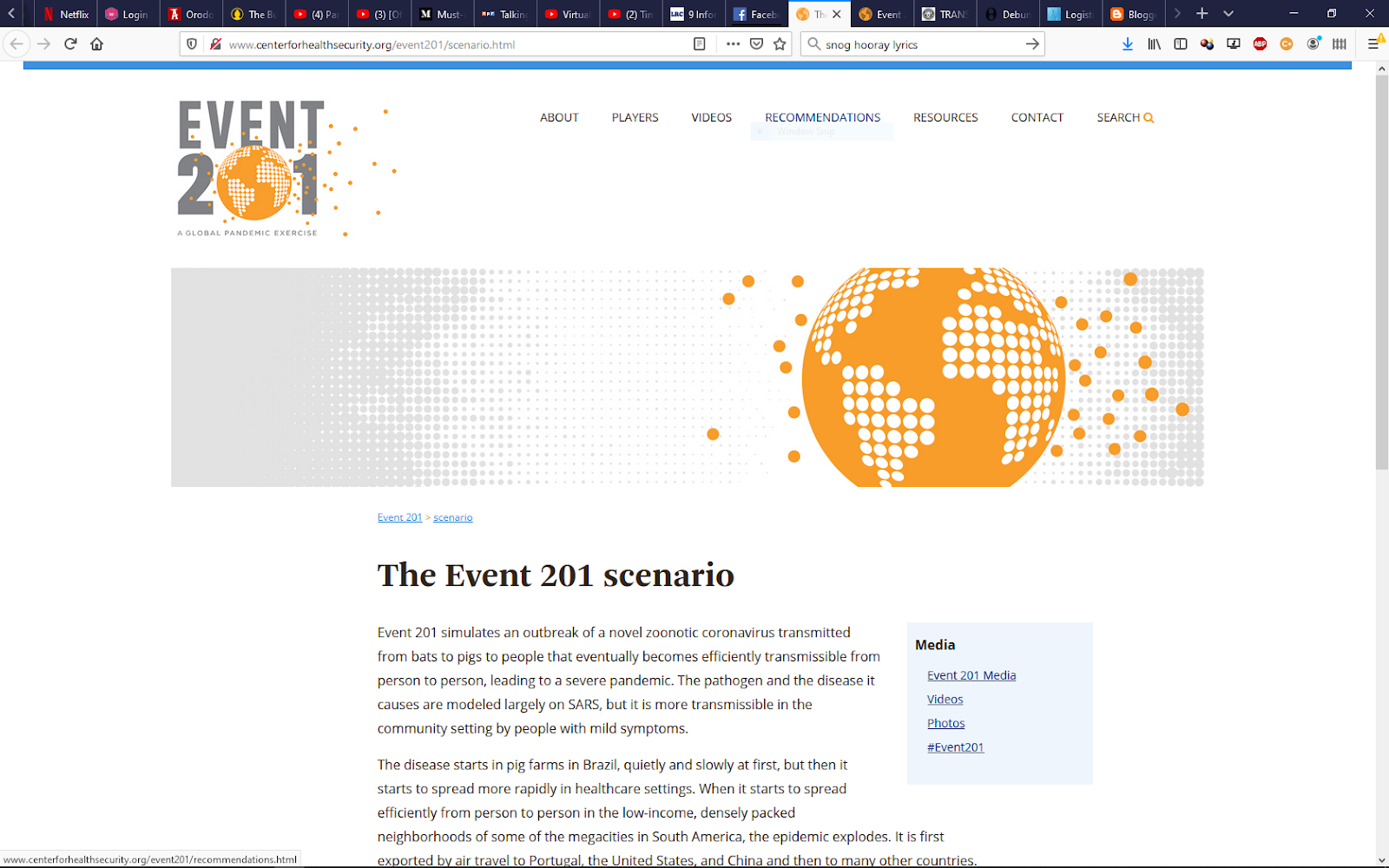

Event 201 simulates an outbreak of a novel zoonotic coronavirus transmitted from bats to pigs to people that eventually becomes efficiently transmissible from person to person, leading to a severe pandemic. The pathogen and the disease it causes are modeled largely on SARS, but it is more transmissible in the community setting by people with mild symptoms.
The disease starts in pig farms in Brazil, quietly and slowly at first, but then it starts to spread more rapidly in healthcare settings. When it starts to spread efficiently from person to person in the low-income, densely packed neighborhoods of some of the megacities in South America, the epidemic explodes. It is first exported by air travel to Portugal, the United States, and China and then to many other countries. Although at first some countries are able to control it, it continues to spread and be reintroduced, and eventually no country can maintain control.
There is no possibility of a vaccine being available in the first year. There is a fictional antiviral drug that can help the sick but not significantly limit spread of the disease.
Since the whole human population is susceptible, during the initial months of the pandemic, the cumulative number of cases increases exponentially, doubling every week. And as the cases and deaths accumulate, the economic and societal consequences become increasingly severe.
The scenario ends at the 18-month point, with 65 million deaths. The pandemic is beginning to slow due to the decreasing number of susceptible people. The pandemic will continue at some rate until there is an effective vaccine or until 80-90 % of the global population has been exposed. From that point on, it is likely to be an endemic childhood disease.
Testing of Coronavirus 'Cure' Set to Start in Australia in Weeks, First Participant in U.S. Vaccine Trial Due to Get First Dose Today
via Newsweek
By Kashmira Gander On 3/16/20 at 6:46 AM EDT
As the COVID-19 pandemic continues, scientists in Australia and the U.S. believe they are a step closer to developing a vaccine and treatment to fight the new coronavirus.
Professor David Paterson, director of the University of Queensland Centre for Clinical Research, told Australian website News.com.au that his team used two existing drugs to deactivate the new coronavirus named SARS-CoV- 2 (not to be confused with the virus which causes SARS), in test tubes. One drug is used against HIV and the other, called chloroquine, treats malaria.
Paterson said the HIV drug was given to some of the first patients to be diagnosed with COVID-19 in Australia, and caused the "disappearance of the virus." The patients have since recovered, he said.
The patients "all did very, very well when they were treated with the HIV drug.
"That's reassuring ... that we're onto something really good here," he said.
The drugs could be called a "treatment or a cure," and a "potentially effective treatment" if found to be effective, he said.
However, Paterson stressed it is important to test the drugs methodically "to give patients "the absolute best treatment rather than just someone's guesses or someone's anecdotal experiences from a few people."
"There have already been patients treated with these in Australia and there's been successful outcomes but it hasn't been done in a controlled or a comparative way," he said.
By the end of March, the team plans to have "very rapidly" enrolled COVID-19 patients on a clinical trial to test the treatment in 50 hospitals across Australia. They will investigate whether the drugs are most effective together or individually.
Meanwhile in the U.S., scientists are due to give a participant in a clinical trial for a vaccine against SARS-CoV-2 their first dose of the preparation on Monday, a government official to the Associated Press news agency on a condition of anonymity, as the decision had not been made public.
The trial is the first for a vaccine for SARS-CoV-2 in people, according to Kaiser Permanente Washington Health Research Institute in Seattle where it's being conducted. The investigational vaccine was created by the biotech company Moderna.
Participants can't be infected by the investigational vaccine called mRNA-1273 as it does not contain SARS-CoV-2, the institution said in a news release. Instead, it contains a genetic code made in a lab, which makes the process of developing the preparation faster.
Over a period of 14 months, a total of 45 participants will take part in the first phase of the trial which will test how safe different doses of the vaccine are, and whether it kicks the immune system into action. The scientists will investigate how effective the vaccine is later down the line. Participants in the trial are required to be aged between 18 to 55-years-old and can't have health conditions or take medications which affect the immune system. Each will receive a total of $1,100 for taking part in the trial.
Since the COVID-19 outbreak started in the central Chinese city of Wuhan late last year, over 169,000 cases have been confirmed and more than 77,000 people have recovered. A total of 6,513 people have died. As indicated in the map by Statista below the virus has reached every continent except Antarctica.
By Kashmira Gander On 3/16/20 at 6:46 AM EDT
As the COVID-19 pandemic continues, scientists in Australia and the U.S. believe they are a step closer to developing a vaccine and treatment to fight the new coronavirus.
Professor David Paterson, director of the University of Queensland Centre for Clinical Research, told Australian website News.com.au that his team used two existing drugs to deactivate the new coronavirus named SARS-CoV- 2 (not to be confused with the virus which causes SARS), in test tubes. One drug is used against HIV and the other, called chloroquine, treats malaria.
Paterson said the HIV drug was given to some of the first patients to be diagnosed with COVID-19 in Australia, and caused the "disappearance of the virus." The patients have since recovered, he said.
The patients "all did very, very well when they were treated with the HIV drug.
"That's reassuring ... that we're onto something really good here," he said.
The drugs could be called a "treatment or a cure," and a "potentially effective treatment" if found to be effective, he said.
However, Paterson stressed it is important to test the drugs methodically "to give patients "the absolute best treatment rather than just someone's guesses or someone's anecdotal experiences from a few people."
"There have already been patients treated with these in Australia and there's been successful outcomes but it hasn't been done in a controlled or a comparative way," he said.
By the end of March, the team plans to have "very rapidly" enrolled COVID-19 patients on a clinical trial to test the treatment in 50 hospitals across Australia. They will investigate whether the drugs are most effective together or individually.
Meanwhile in the U.S., scientists are due to give a participant in a clinical trial for a vaccine against SARS-CoV-2 their first dose of the preparation on Monday, a government official to the Associated Press news agency on a condition of anonymity, as the decision had not been made public.
The trial is the first for a vaccine for SARS-CoV-2 in people, according to Kaiser Permanente Washington Health Research Institute in Seattle where it's being conducted. The investigational vaccine was created by the biotech company Moderna.
Participants can't be infected by the investigational vaccine called mRNA-1273 as it does not contain SARS-CoV-2, the institution said in a news release. Instead, it contains a genetic code made in a lab, which makes the process of developing the preparation faster.
Over a period of 14 months, a total of 45 participants will take part in the first phase of the trial which will test how safe different doses of the vaccine are, and whether it kicks the immune system into action. The scientists will investigate how effective the vaccine is later down the line. Participants in the trial are required to be aged between 18 to 55-years-old and can't have health conditions or take medications which affect the immune system. Each will receive a total of $1,100 for taking part in the trial.
Since the COVID-19 outbreak started in the central Chinese city of Wuhan late last year, over 169,000 cases have been confirmed and more than 77,000 people have recovered. A total of 6,513 people have died. As indicated in the map by Statista below the virus has reached every continent except Antarctica.
Canada Investigates China’s Biological Espionage
By
GreatGameIndia -
August 8, 2019 | Last modified on February 29th, 2020 at 9:55 pm,
Canada has launched an investigation into China’s Biological Espionage. Bio-warfare experts question why Canada was sending lethal viruses to China.
In a table-top pandemic exercise at Johns Hopkins University last year, a pathogen based on the emerging Nipah virus was released by fictional extremists, killing 150 million people.
A less apocalyptic scenario mapped out by a blue-ribbon U.S. panel envisioned Nipah being dispersed by terrorists and claiming over 6,000 American lives.
Scientists from Canada’s National Microbiology Laboratory (NML) have also said the highly lethal bug is a potential bio-weapon.
But this March that same lab shipped samples of the henipavirus family and of Ebola to China, which has long been suspected of running a secretive biological warfare program.
China strongly denies it makes germ weapons, and Canadian officials say the shipment was part of its efforts to support public-health research worldwide. Sharing of such samples internationally is relatively standard practice.
But some experts are raising questions about the March transfer, which appears to be at the centre of a shadowy RCMP investigation and dismissal of a top scientist at the Winnipeg-based NML.
“I would say this Canadian ‘contribution’ might likely be counterproductive,” said Dany Shoham, a biological and chemical warfare expert at Israel’s Bar-Ilan University. “I think the Chinese activities … are highly suspicious, in terms of exploring (at least) those viruses as BW agents. “
James Giordano, a neurology professor at Georgetown University and senior fellow in biowarfare at the U.S. Special Operations Command, said it’s worrisome on a few fronts.
China’s growing investment in bio-science, looser ethics around gene-editing and other cutting-edge technology and integration between government and academia raise the spectre of such pathogens being weaponized, he said.
That could mean an offensive agent, or a modified germ let loose by proxies, for which only China has the treatment or vaccine, said Giordano, co-head of Georgetown’s Brain Science and Global Law and Policy Program.
“This is not warfare, per se,” he said. “But what it’s doing is leveraging the capability to act as global saviour, which then creates various levels of macro and micro economic and bio-power dependencies.”
Asked if the possibility of the Canadian germs being diverted into a Chinese bio weapons program is connected to other upheaval at the microbiology lab, Public Health Agency of Canada spokeswoman Anna Maddison said this week the agency “continues to look into the administrative matter.”
The agency divulged last week that it sent samples of Ebola and henipavirus — which includes Nipah and the related Hendra — to China in March. It was meant for virus research, part of the agency’s mission to back international public-health research, a spokesman said.
Last month, an acclaimed NML scientist — Xiangguo Qiu — was reportedly escorted out of the lab along with her husband, another biologist, and members of her research team. The agency said it was investigating an “administrative issue,” and had referred a possible policy breach to the RCMP. Little more has been said about the affair.
China has been a signatory to the Biological Weapons Convention since 1984, and has repeatedly insisted it is abiding by the treaty that bans developing bio-weapons.
But suspicions have persisted, with the U.S. State Department and other agencies stating publicly as recently as 2009 that they believe China has offensive biological agents.
Though no details have appeared in the open literature, China is “commonly considered to have an active biological warfare program,” says the Federation of American Scientists. An official with the U.S. Army Medical Research Institute of Chemical Defence charged last month China is the world leader in toxin “threats.”
In a 2015 academic paper, Shoham – of Bar-Ilan’s Begin-Sadat Center for Strategic Studies – asserts that more than 40 Chinese facilities are involved in bio-weapon production.
China’s Academy of Military Medical Sciences actually developed an Ebola drug – called JK-05 — but little has been divulged about it or the defence facility’s possession of the virus, prompting speculation its Ebola cells are part of China’s bio-warfare arsenal, Shoham told the National Post.
Ebola is classified as a “category A” bioterrorism agent by the U.S. Centers for Disease Control and Prevention, meaning it could be easily transmitted from person to person, would result in high death rates and “might cause panic.” The CDC lists Nipah as a category C substance, a deadly emerging pathogen that could be engineered for mass dissemination.
Nipah, which was first seen in Malaysia in 1998, has caused a series of outbreaks across east and south Asia, with death rates mostly over 50 per cent, and as high as 100 per cent, according to World Health Organization figures. It can cause encephalitis, an often-fatal brain swelling, and has no known treatment or vaccine.
The Johns Hopkins exercise — called Clade X — involved a version of Nipah modified to be more easily passed between people. America’s Blue Ribbon Study Panel on Biodefence prefaced its 2015 report with a scenario involving the intentional release of Nipah by aerosol spray.
China’s extensive and controversial use of CRISPR gene-editing and weaponizing Biotechnology makes it conceivable the country could bio-engineer germs like Nipah to make them even more dangerous, Giordano said.
GreatGameIndia -
August 8, 2019 | Last modified on February 29th, 2020 at 9:55 pm,
Canada has launched an investigation into China’s Biological Espionage. Bio-warfare experts question why Canada was sending lethal viruses to China.
In a table-top pandemic exercise at Johns Hopkins University last year, a pathogen based on the emerging Nipah virus was released by fictional extremists, killing 150 million people.
A less apocalyptic scenario mapped out by a blue-ribbon U.S. panel envisioned Nipah being dispersed by terrorists and claiming over 6,000 American lives.
Scientists from Canada’s National Microbiology Laboratory (NML) have also said the highly lethal bug is a potential bio-weapon.
But this March that same lab shipped samples of the henipavirus family and of Ebola to China, which has long been suspected of running a secretive biological warfare program.
China strongly denies it makes germ weapons, and Canadian officials say the shipment was part of its efforts to support public-health research worldwide. Sharing of such samples internationally is relatively standard practice.
But some experts are raising questions about the March transfer, which appears to be at the centre of a shadowy RCMP investigation and dismissal of a top scientist at the Winnipeg-based NML.
“I would say this Canadian ‘contribution’ might likely be counterproductive,” said Dany Shoham, a biological and chemical warfare expert at Israel’s Bar-Ilan University. “I think the Chinese activities … are highly suspicious, in terms of exploring (at least) those viruses as BW agents. “
James Giordano, a neurology professor at Georgetown University and senior fellow in biowarfare at the U.S. Special Operations Command, said it’s worrisome on a few fronts.
China’s growing investment in bio-science, looser ethics around gene-editing and other cutting-edge technology and integration between government and academia raise the spectre of such pathogens being weaponized, he said.
That could mean an offensive agent, or a modified germ let loose by proxies, for which only China has the treatment or vaccine, said Giordano, co-head of Georgetown’s Brain Science and Global Law and Policy Program.
“This is not warfare, per se,” he said. “But what it’s doing is leveraging the capability to act as global saviour, which then creates various levels of macro and micro economic and bio-power dependencies.”
Asked if the possibility of the Canadian germs being diverted into a Chinese bio weapons program is connected to other upheaval at the microbiology lab, Public Health Agency of Canada spokeswoman Anna Maddison said this week the agency “continues to look into the administrative matter.”
The agency divulged last week that it sent samples of Ebola and henipavirus — which includes Nipah and the related Hendra — to China in March. It was meant for virus research, part of the agency’s mission to back international public-health research, a spokesman said.
Last month, an acclaimed NML scientist — Xiangguo Qiu — was reportedly escorted out of the lab along with her husband, another biologist, and members of her research team. The agency said it was investigating an “administrative issue,” and had referred a possible policy breach to the RCMP. Little more has been said about the affair.
China has been a signatory to the Biological Weapons Convention since 1984, and has repeatedly insisted it is abiding by the treaty that bans developing bio-weapons.
But suspicions have persisted, with the U.S. State Department and other agencies stating publicly as recently as 2009 that they believe China has offensive biological agents.
Though no details have appeared in the open literature, China is “commonly considered to have an active biological warfare program,” says the Federation of American Scientists. An official with the U.S. Army Medical Research Institute of Chemical Defence charged last month China is the world leader in toxin “threats.”
In a 2015 academic paper, Shoham – of Bar-Ilan’s Begin-Sadat Center for Strategic Studies – asserts that more than 40 Chinese facilities are involved in bio-weapon production.
China’s Academy of Military Medical Sciences actually developed an Ebola drug – called JK-05 — but little has been divulged about it or the defence facility’s possession of the virus, prompting speculation its Ebola cells are part of China’s bio-warfare arsenal, Shoham told the National Post.
Ebola is classified as a “category A” bioterrorism agent by the U.S. Centers for Disease Control and Prevention, meaning it could be easily transmitted from person to person, would result in high death rates and “might cause panic.” The CDC lists Nipah as a category C substance, a deadly emerging pathogen that could be engineered for mass dissemination.
Nipah, which was first seen in Malaysia in 1998, has caused a series of outbreaks across east and south Asia, with death rates mostly over 50 per cent, and as high as 100 per cent, according to World Health Organization figures. It can cause encephalitis, an often-fatal brain swelling, and has no known treatment or vaccine.
The Johns Hopkins exercise — called Clade X — involved a version of Nipah modified to be more easily passed between people. America’s Blue Ribbon Study Panel on Biodefence prefaced its 2015 report with a scenario involving the intentional release of Nipah by aerosol spray.
China’s extensive and controversial use of CRISPR gene-editing and weaponizing Biotechnology makes it conceivable the country could bio-engineer germs like Nipah to make them even more dangerous, Giordano said.
Inside the Chinese lab poised to study world's most dangerous pathogens
via Nature
Maximum-security biolab is part of plan to build network of BSL-4 facilities across China.
A laboratory in Wuhan is on the cusp of being cleared to work with the world’s most dangerous pathogens. The move is part of a plan to build between five and seven biosafety level-4 (BSL-4) labs across the Chinese mainland by 2025, and has generated much excitement, as well as some concerns.
Some scientists outside China worry about pathogens escaping, and the addition of a biological dimension to geopolitical tensions between China and other nations. But Chinese microbiologists are celebrating their entrance to the elite cadre empowered to wrestle with the world’s greatest biological threats.
“It will offer more opportunities for Chinese researchers, and our contribution on the BSL‑4-level pathogens will benefit the world,” says George Gao, director of the Chinese Academy of Sciences Key Laboratory of Pathogenic Microbiology and Immunology in Beijing. There are already two BSL-4 labs in Taiwan, but the National Bio-safety Laboratory, Wuhan, would be the first on the Chinese mainland.
The lab was certified as meeting the standards and criteria of BSL-4 by the China National Accreditation Service for Conformity Assessment (CNAS) in January. The CNAS examined the lab’s infrastructure, equipment and management, says a CNAS representative, paving the way for the Ministry of Health to give its approval. A representative from the ministry says it will move slowly and cautiously; if the assessment goes smoothly, it could approve the laboratory by the end of June.
BSL-4 is the highest level of biocontainment: its criteria include filtering air and treating water and waste before they leave the laboratory, and stipulating that researchers change clothes and shower before and after using lab facilities. Such labs are often controversial. The first BSL-4 lab in Japan was built in 1981, but operated with lower-risk pathogens until 2015, when safety concerns were finally overcome.
The expansion of BSL-4-lab networks in the United States and Europe over the past 15 years — with more than a dozen now in operation or under construction in each region — also met with resistance, including questions about the need for so many facilities.
The Wuhan lab cost 300 million yuan (US$44 million), and to allay safety concerns it was built far above the flood plain and with the capacity to withstand a magnitude-7 earthquake, although the area has no history of strong earthquakes. It will focus on the control of emerging diseases, store purified viruses and act as a World Health Organization ‘reference laboratory’ linked to similar labs around the world. “It will be a key node in the global biosafety-lab network,” says lab director Yuan Zhiming.
The Chinese Academy of Sciences approved the construction of a BSL-4 laboratory in 2003, and the epidemic of SARS (severe acute respiratory syndrome) around the same time lent the project momentum. The lab was designed and constructed with French assistance as part of a 2004 cooperative agreement on the prevention and control of emerging infectious diseases. But the complexity of the project, China’s lack of experience, difficulty in maintaining funding and long government approval procedures meant that construction wasn’t finished until the end of 2014.
The lab’s first project will be to study the BSL-3 pathogen that causes Crimean–Congo haemorrhagic fever: a deadly tick-borne virus that affects livestock across the world, including in northwest China, and that can jump to people.
Future plans include studying the pathogen that causes SARS, which also doesn’t require a BSL-4 lab, before moving on to Ebola and the West African Lassa virus, which do. Some one million Chinese people work in Africa; the country needs to be ready for any eventuality, says Yuan. “Viruses don’t know borders.”
Gao travelled to Sierra Leone during the recent Ebola outbreak, allowing his team to report the speed with which the virus mutated into new strains1. The Wuhan lab will give his group a chance to study how such viruses cause disease, and to develop treatments based on antibodies and small molecules, he says.
The opportunities for international collaboration, meanwhile, will aid the genetic analysis and epidemiology of emergent diseases. “The world is facing more new emerging viruses, and we need more contribution from China,” says Gao. In particular, the emergence of zoonotic viruses — those that jump to humans from animals, such as SARS or Ebola — is a concern, says Bruno Lina, director of the VirPath virology lab in Lyon, France.
Many staff from the Wuhan lab have been training at a BSL-4 lab in Lyon, which some scientists find reassuring. And the facility has already carried out a test-run using a low-risk virus.
But worries surround the Chinese lab, too. The SARS virus has escaped from high-level containment facilities in Beijing multiple times, notes Richard Ebright, a molecular biologist at Rutgers University in Piscataway, New Jersey. Tim Trevan, founder of CHROME Biosafety and Biosecurity Consulting in Damascus, Maryland, says that an open culture is important to keeping BSL-4 labs safe, and he questions how easy this will be in China, where society emphasizes hierarchy. “Diversity of viewpoint, flat structures where everyone feels free to speak up and openness of information are important,” he says.
Yuan says that he has worked to address this issue with staff. “We tell them the most important thing is that they report what they have or haven’t done,” he says. And the lab’s international collaborations will increase openness. “Transparency is the basis of the lab,” he adds.
The plan to expand into a network heightens such concerns. One BSL-4 lab in Harbin is already awaiting accreditation; the next two are expected to be in Beijing and Kunming, the latter focused on using monkey models to study disease.
Lina says that China’s size justifies this scale, and that the opportunity to combine BSL-4 research with an abundance of research monkeys — Chinese researchers face less red tape than those in the West when it comes to research on primates — could be powerful. “If you want to test vaccines or antivirals, you need a non-human primate model,” says Lina.
But Ebright is not convinced of the need for more than one BSL-4 lab in mainland China. He suspects that the expansion there is a reaction to the networks in the United States and Europe, which he says are also unwarranted. He adds that governments will assume that such excess capacity is for the potential development of bioweapons.
“These facilities are inherently dual use,” he says. The prospect of ramping up opportunities to inject monkeys with pathogens also worries, rather than excites, him: “They can run, they can scratch, they can bite.”
Trevan says China’s investment in a BSL-4 lab may, above all, be a way to prove to the world that the nation is competitive. “It is a big status symbol in biology,” he says, “whether it’s a need or not.”
Nature
542,
399–400
(23 February 2017)
doi:10.1038/nature.2017.21487
Maximum-security biolab is part of plan to build network of BSL-4 facilities across China.
A laboratory in Wuhan is on the cusp of being cleared to work with the world’s most dangerous pathogens. The move is part of a plan to build between five and seven biosafety level-4 (BSL-4) labs across the Chinese mainland by 2025, and has generated much excitement, as well as some concerns.
Some scientists outside China worry about pathogens escaping, and the addition of a biological dimension to geopolitical tensions between China and other nations. But Chinese microbiologists are celebrating their entrance to the elite cadre empowered to wrestle with the world’s greatest biological threats.
“It will offer more opportunities for Chinese researchers, and our contribution on the BSL‑4-level pathogens will benefit the world,” says George Gao, director of the Chinese Academy of Sciences Key Laboratory of Pathogenic Microbiology and Immunology in Beijing. There are already two BSL-4 labs in Taiwan, but the National Bio-safety Laboratory, Wuhan, would be the first on the Chinese mainland.
The lab was certified as meeting the standards and criteria of BSL-4 by the China National Accreditation Service for Conformity Assessment (CNAS) in January. The CNAS examined the lab’s infrastructure, equipment and management, says a CNAS representative, paving the way for the Ministry of Health to give its approval. A representative from the ministry says it will move slowly and cautiously; if the assessment goes smoothly, it could approve the laboratory by the end of June.
BSL-4 is the highest level of biocontainment: its criteria include filtering air and treating water and waste before they leave the laboratory, and stipulating that researchers change clothes and shower before and after using lab facilities. Such labs are often controversial. The first BSL-4 lab in Japan was built in 1981, but operated with lower-risk pathogens until 2015, when safety concerns were finally overcome.
The expansion of BSL-4-lab networks in the United States and Europe over the past 15 years — with more than a dozen now in operation or under construction in each region — also met with resistance, including questions about the need for so many facilities.
The Wuhan lab cost 300 million yuan (US$44 million), and to allay safety concerns it was built far above the flood plain and with the capacity to withstand a magnitude-7 earthquake, although the area has no history of strong earthquakes. It will focus on the control of emerging diseases, store purified viruses and act as a World Health Organization ‘reference laboratory’ linked to similar labs around the world. “It will be a key node in the global biosafety-lab network,” says lab director Yuan Zhiming.
The Chinese Academy of Sciences approved the construction of a BSL-4 laboratory in 2003, and the epidemic of SARS (severe acute respiratory syndrome) around the same time lent the project momentum. The lab was designed and constructed with French assistance as part of a 2004 cooperative agreement on the prevention and control of emerging infectious diseases. But the complexity of the project, China’s lack of experience, difficulty in maintaining funding and long government approval procedures meant that construction wasn’t finished until the end of 2014.
The lab’s first project will be to study the BSL-3 pathogen that causes Crimean–Congo haemorrhagic fever: a deadly tick-borne virus that affects livestock across the world, including in northwest China, and that can jump to people.
Future plans include studying the pathogen that causes SARS, which also doesn’t require a BSL-4 lab, before moving on to Ebola and the West African Lassa virus, which do. Some one million Chinese people work in Africa; the country needs to be ready for any eventuality, says Yuan. “Viruses don’t know borders.”
Gao travelled to Sierra Leone during the recent Ebola outbreak, allowing his team to report the speed with which the virus mutated into new strains1. The Wuhan lab will give his group a chance to study how such viruses cause disease, and to develop treatments based on antibodies and small molecules, he says.
The opportunities for international collaboration, meanwhile, will aid the genetic analysis and epidemiology of emergent diseases. “The world is facing more new emerging viruses, and we need more contribution from China,” says Gao. In particular, the emergence of zoonotic viruses — those that jump to humans from animals, such as SARS or Ebola — is a concern, says Bruno Lina, director of the VirPath virology lab in Lyon, France.
Many staff from the Wuhan lab have been training at a BSL-4 lab in Lyon, which some scientists find reassuring. And the facility has already carried out a test-run using a low-risk virus.
But worries surround the Chinese lab, too. The SARS virus has escaped from high-level containment facilities in Beijing multiple times, notes Richard Ebright, a molecular biologist at Rutgers University in Piscataway, New Jersey. Tim Trevan, founder of CHROME Biosafety and Biosecurity Consulting in Damascus, Maryland, says that an open culture is important to keeping BSL-4 labs safe, and he questions how easy this will be in China, where society emphasizes hierarchy. “Diversity of viewpoint, flat structures where everyone feels free to speak up and openness of information are important,” he says.
Yuan says that he has worked to address this issue with staff. “We tell them the most important thing is that they report what they have or haven’t done,” he says. And the lab’s international collaborations will increase openness. “Transparency is the basis of the lab,” he adds.
The plan to expand into a network heightens such concerns. One BSL-4 lab in Harbin is already awaiting accreditation; the next two are expected to be in Beijing and Kunming, the latter focused on using monkey models to study disease.
Lina says that China’s size justifies this scale, and that the opportunity to combine BSL-4 research with an abundance of research monkeys — Chinese researchers face less red tape than those in the West when it comes to research on primates — could be powerful. “If you want to test vaccines or antivirals, you need a non-human primate model,” says Lina.
But Ebright is not convinced of the need for more than one BSL-4 lab in mainland China. He suspects that the expansion there is a reaction to the networks in the United States and Europe, which he says are also unwarranted. He adds that governments will assume that such excess capacity is for the potential development of bioweapons.
“These facilities are inherently dual use,” he says. The prospect of ramping up opportunities to inject monkeys with pathogens also worries, rather than excites, him: “They can run, they can scratch, they can bite.”
Trevan says China’s investment in a BSL-4 lab may, above all, be a way to prove to the world that the nation is competitive. “It is a big status symbol in biology,” he says, “whether it’s a need or not.”
Nature
542,
399–400
(23 February 2017)
doi:10.1038/nature.2017.21487
Sunday, October 6, 2019
Face, accept, float, let time pass: Claire Weekes' anxiety cure holds true decades on
via The Age
On October 23, 1977, a diminutive Australian stepped onto the stage in New York. The audience saw an elderly woman whose regular uniform was a tweed skirt, twinset, spectacles, and sensible brown lace-up shoes with low heels. Her dark hair was permed and for adornment, she wore a string of pearls. At the age of 74, Dr Claire Weekes was the guest speaker at the 18th Annual Fall Conference of the Association for the Advancement of Psychotherapy. She was an unusual choice for this gathering, as she ranked as an unqualified outsider.
However, Weekes had one measurable claim to fame: her books on anxiety were a global sensation, hitting the bestseller lists in the US and the UK from the early 1960s onwards. She’d found a popular audience by identifying and describing the havoc nervous illness could create, and explaining and treating it in a fresh way. Weekes had been invited to address this professional association despite divided opinion over her approach. Many psychiatrists had heard of her methods from their patients, and a number accepted that some patients they had treated unsuccessfully had read her books and felt, if not entirely cured, then on the way to recovery.
While her audience saw a populist, Weekes started life as a scholar, an evolutionary scientist. In 1930 she made history as the first woman to gain a doctorate of science at the University of Sydney, and also won the university medal in zoology. By then she already had an international reputation in her field, which lives as vigorously today in academic circles as her work on nerves thrives in the popular market.
In 1945, she qualified as a medical doctor, eventually becoming a specialist general physician dealing with difficult-to-diagnose cases. She then hurdled what was then the highest bar in medicine, being selected as a fellow of the Royal Australasian College of Physicians. Her medical peers recognised what went unappreciated by her New York audience: Weekes was a scientist and a doctor who had mastered an understanding of the nervous system.
Yet on the podium in New York, Weekes inspired no awe and many in the audience dismissed her as offering nothing more than the equivalent of grandmotherly advice. She was the author of self-help books, not a psychiatrist, and she was in huge demand in the media. Her fame invited critical attention to her lack of specialist credentials, which was enough to wound her reputation in her own profession.
The psychiatrists in the New York audience fell into one of two schools. They were either psychoanalysts, who followed the techniques of Sigmund Freud and his intellectual descendants, or cognitive behaviourists, who worked on changing habits of thought and associated behaviours. Weekes’ approach could not have been further from that of Freud. Referring to the legendary psychiatrist’s pioneering technique of interrogating his patients while they were prone, Weekes boasted of being “one of the first to deal a blow at the old Viennese couch technique. I led them out of the consulting room, into the world where they were to live successfully.” She was equally critical of attempts by the behaviourists to “desensitise” their patients using relaxation techniques.
She understood that trying to teach a patient to relax in the face of phobia or panic was not only counterproductive but an almost impossible mission. Instead, she argued that by fully experiencing the panic, the individual learnt it was possible to “pass through” to the other side. Their nervous system needed to be reordered, which they could learn to do themselves. They didn’t then need a shepherd or psychiatrist.
“To recover, they must know how to face, accept and go through panic until it no longer matters …” Weekes said. “Recovery is in their own hands, not in drugs, not in avoidance of panic, not in ‘getting used to’ difficult situations, nor in desensitisation by suggestion. Permanent recovery lies in the patient’s ability to know how to accept the panic until he no longer fears it.”
The New York audience made her acutely aware of their disdain. They looked at their watches and talked among themselves, and the famous South African psychiatrist Dr Joseph Wolpe tore her to pieces after she dared challenge an approach to treatment that he favoured. At least one psychiatrist in the audience appreciated her pioneering work, however. Dr Manuel Zane, who ran a New York clinic for anxiety and phobia, had firsthand experience of the success of her method, even with intractable cases.
“The remarkable thing was that patients came to me talking about her,” Zane wrote in a nomination he made for Weekes for a Nobel Prize in the late 1980s. “That was the difference between Weekes and other professionals. She was coming to us from where the patient is, and not from our top, where we were telling patients what it’s all about, why they are the way they are.” Weekes also offered something unique to the field: hope.
Years later, Weekes chided another professional audience. “I am aware that many therapists believe there is no permanent cure for nervous illness. When I was on the radio some years ago in New York with a physician and a psychiatrist, the psychiatrist corrected me when I used the word ‘cure’ and said, ‘You mean remission, don’t you, Dr Weekes? We never speak of curing nervous illness!’ I told her that I had cured far too many nervously ill people to be afraid to use the word.”
It was a provocative claim, but one that sat on an unshakeable foundation. Weekes’ work anticipated advances made decades later in both neurology and psychiatry, and her approach, akin to modern psychology’s Acceptance and Commitment Therapy (ACT), has been vindicated. She changed the way anxiety was understood and treated, yet her huge global footprint is invisible, and her achievement remains largely unrecognised by professionals.
Hazel Claire Weekes was born in 1903 into a modest middle-class Sydney home. Her father, Ralph, was a musician, and this clever eldest daughter of four children was the favourite of her mother Fan, a preference all too obvious to Weekes’ two brothers and younger sister. Fiercely proud of this child, who showed early scholarly success, Fan determined to see her daughter fulfil her promise. So off Weekes went to Sydney University, securing her first-class honours degree in science and university medal.
In 1928, at the age of 25, she identified a new challenge: a Rockefeller Fellowship, with which she planned to further her evolutionary studies in England after completing her PhD. But before she got there, she lost her footing and found herself in freefall. It started with a sore throat, followed by a botched operation on septic tonsils resulting in a haemorrhage.
“I’d had severely infected tonsils. I’d eaten very little for months and had lost two stone,” she said years later in an interview with the BBC. For a small, slightly built woman, 13 kilograms was a significant weight loss. In her weakened state, she experienced heart palpitations and was referred to a Sydney specialist she knew as a “famous cardiologist”, who gave her injections of calcium, which had little or no effect.
Fragile, emaciated, and with a racing heart, Weekes was a puzzle to her local doctor, who finally, with scant evidence, made a monumental diagnosis. He concluded she had contracted the dreaded disease of the day, tuberculosis. “I thought I was dying,” she recalled in a letter to a friend. “I was sent away to the country and I was told that I must make no effort, not even to pull a blind down.” Tuberculosis invoked the terror of the Black Plague of earlier years; the public response to it was a preview of that to the HIV/AIDS epidemic to come generations later.
Her studies were put on hold, and the young woman who hated being alone was packed off to the Waterfall State Sanatorium, 38 kilometres south of the Sydney CBD. Here there was no occupation and no one to keep Weekes company in the face of the death and dying around her. Her heart continued to race. “I was more or less confined to lying on the couch, with nothing much to do, and six months on my hands. So that I knew what it was to become introverted, worried,” she said of that period.
The sanatorium was the perfect petri dish for a fear that would grip and not let go. Yet Weekes was one of the lucky ones, for, after six months, the doors of the sanatorium swung open. The doctors concluded a mistake had been made; that she’d been wrongly diagnosed. Far from being relieved, Weekes felt immeasurably worse. Now she was convinced that she had a serious heart complaint as the tachycardia, or racing heart, was unceasing. Once outside the sanatorium, she was terrified and overwhelmed.
“I can remember, I had lost all confidence in what I could do, because I’d been told, ‘You mustn’t do this, you mustn’t do that!’ I remember walking out alone and thinking, ‘I wonder if I can walk as far as the corner of that street?’ I remember being aware of every footstep I took, and wondering how much faith I could still have in my body to get there,” she said in a media interview years later.
Rather than immediately returning to university, she chose to recuperate in “the country” with a female friend who was married to a doctor. Weekes hoped for some advice on her heart problems, but instead, found more medical incompetence.
“My heart would palpitate if I woke up at night, just the shock of waking up would make it accelerate. I can remember very clearly how, one night, I called out to her when my heart was beating fiercely and thought my last gasp was coming. Her husband, the doctor, said, ‘No. I won’t go to help her. She’ll think she’s worse than she really is!’”
The doctor was right in one respect. There was nothing wrong with Weekes’ heart. She was to live for another six decades. However, something important had gone unexplained. It was fear that was managing her heartbeat, and, without knowing this, she was trapped in a vicious cycle. It would be years before she cracked the anxiety code.
In 1929, aged 26 and not long out of the sanatorium, an unsteady Weekes boarded a Dutch liner. With a professional record that eluded most men of her generation, and the backing of eminent scientists in her field, she was finally heading to England on that Rockefeller scholarship, bound for University College London, where she would continue her studies in evolution.
The rhythm and vibrations of the ship helped camouflage the movements in her body, and she regained composure for the first time in two years. Yet on stepping ashore, a rapidly beating heart reclaimed her. The return of her symptoms was devastating. At night, she would just be dropping off to sleep when she’d wake with a start. “Then I would sit up for hours for fear that I would die if I lay down.” There was no way out. Newly arrived in London but close to collapse, she felt keenly the paradox of her situation. “I had everything to live for and I knew it. I had achieved so much, the whole of life lay before me, but I was incapacitated.”
The potency of this experience would inform her advice, many years later, to patients and readers.
She knew the return of fear carried with it real despair, the death of the hope so badly needed but impossible to secure. In her books, she had a typically practical word to describe this state: simply, a “setback”. It was not defeat, she counselled, but was to be embraced as an opportunity to practise.
Stress, fear and panic could return, but it was possible to learn how to ride the terrifying waves back to the shoreline. In this way, what she would later call “the habit of fear” could be broken. Not long after she began working in her University College lab, a friend came to visit. Beyond dissembling, her first words to him were: “Oh, I can’t take this any longer. I’ve had it!” When told of her racing heart and indescribable distress, far from being surprised or concerned, he shrugged.
“That is nothing,” he said. “Those are only the symptoms of nerves. We all had those in the [World War I] trenches.” He told Weekes that her heart continued to race because she was frightened of it. It was programmed by her fear. This made immediate sense. “All the time I have been doing this to myself?” she asked. “He said ‘yes’ and laughed,” she would later recount.
His words spoke to the scientist in Weekes. War offered empirical examples: men got scared, their hearts raced, and they often continued to race after the threat had passed. Her friend, decorated for bravery in the savage battle of the Somme, had noticed that he and his fellow soldiers had become distressed by their racing hearts, which further aroused and primed them for panic. Yet there was nothing wrong with their hearts. They were consumed with a fear that felt overwhelming in the body, so the mind concluded something was terribly wrong and continued to feed the fear.
Fear could not be extinguished by the rational brain. Thinking inevitably lost the battle to feeling. Weekes’ substantial cognitive abilities, which delivered scholarships, awards and opportunities, were sidelined by an all-consuming dread. It was this feeling she was desperate to extinguish, this feeling against which she fought so futilely, this feeling that was accompanied by racing panicked thoughts.
The discovery that she’d been frightened of fear itself was a profound revelation. Weekes was shocked that not one of the handful of doctors and specialists she’d consulted had explained how fear could have such a deranging effect on the body. She immediately grasped the point that she needed to stop fighting the fear, an instinctive response yet counterproductive. There was no benefit gained by striving, trying to think rationally, or attempting to exercise willpower. She later reported it as the breakthrough insight.
“After my friend told me the cause, I just lay as calmly as I could, ‘Okay, I’ll just go to sleep, palpitating if necessary.’ ” When she ceased engaging so intensely with her symptoms, her heartbeat returned to normal. “The whole thing cleared up,” as she put it. Once she understood “fear” was bluffing her, she decided to ignore the messenger. She accepted the palpitations instead of fighting them. No battle, no fighting. The keyword was “acceptance”.
The turnaround was swift. If Weekes had been devastated by her lack of understanding of what ailed her, she now felt exhilarated, liberated by an explanation from what had been incomprehensible suffering. With this new understanding, she regained control. Her friend had planted the seed for the bestselling books that Weekes would eventually write, but years of professional medical experience were needed to shape this single brilliant insight of acceptance into a comprehensive understanding of the anxiety state.
Weekes’ own distress, which had so piqued her interest in “nerves”, was to find its professional purpose back in Sydney, when she began practising as a doctor, first in Bondi and then as a specialist general physician in Macquarie Street. Here she learnt that panic and anxiety played a medley of dissonant bodily tunes, from breathing, swallowing and digestive difficulties to headaches, dizziness and muscle fatigue among many others.
Now other doctors began to refer their difficult cases to her. With the support of her partner, the accomplished pianist Elizabeth (Beth) Coleman, and her mother Fan, she had unlimited time and sympathy for anxious patients. Determined not to be like the doctor who had long ago failed to ease her own suffering by explaining the effects of fear on mind and body, her dedication to those she deemed nervously ill went far beyond any normal professional boundary. She even invited some of them to live in her home, to better help their recovery.
Weekes knew the effect anxiety had on the body, later describing in her books “the whiplash of panic” and the “electrifying quality of sensitised panic” to communicate to a non-sufferer the way in which continued distress prepared the body to ever more swiftly respond. The nervous system became primed to experience anxiety more quickly and savagely than ever. It had become “sensitised”, and understanding this process was the key to recovery. Desensitisation would follow as a natural consequence. That is, there was no need to practise becoming desensitised to whatever was particularly feared.
So instead of structured exposure to fears, she prescribed total acceptance of the fear as the way out of distress and panic. The problem was inside, not outside. To address it required total acceptance of what felt unacceptable. For it was exactly this fighting against tension, fear, anxiety and panic that perpetuated the problem. Weekes’ treatment protocol was just six words: face, accept, float, let time pass. It was not designed to eradicate all the stresses of life, but to enable people to find their own way out of distress. It was, she would later say, simple but not always easy. Her point was that it worked.
Weekes put her success as a doctor down to her scientific training, telling the BBC years later that it allowed her to see the trunk of the tree, rather than being distracted by the leaves. She had a gift for discerning the relationship between the mind and the body – what was clinical illness and what were symptoms driven by fear and anxiety. Understanding fear and its relationship to physical illness had become a mission.
Such was her success that throughout the 1950s, people were referred to her from across the nation.
She came to believe she had something unique to offer the huge, unmet market for effective treatment for severe anxiety. In 1962, she wrote the prosaically titled Self-Help for Your Nerves, and by the time she was standing on the podium in New York 15 years later, there had been two more books, which were prominently displayed in airports and translated into at least eight languages.
Two more were to follow in the next decade. She later explained to an American doctor that, instead of writing research papers, she had seen “the need was so great” that she went directly to the people.
The books were slim volumes that explained the nervous system and how it could go awry, how the mind and body were interconnected in arousal, and the trouble this could cause. Yet the clarity of work that drove the books’ runaway success also repelled professional recognition. Self-help was not yet a genre that inspired psychiatrists’ attention or respect. In a field more familiar with failure, and one riven with division, Weekes achieved success and as psychoanalysts struggled to prove that their methods worked, Weekes had the numbers running in her favour. People bought her books and queued to thank her for “saving” their lives. She was writing about “them”, and they often chose a religious metaphor to express their gratitude: the books were their “bible”.
Weekes died in 1990, aged 87. Along the way, she’d hurdled a series of different careers – evolutionary scientist, travel writer, singing coach, GP – and it was a lifetime of scholarship and deep experience of the anxiety state, as well as exceptional communications skills, that delivered the books that saved lives, and changed history.
People as diverse as 1960s housewives, the daughter of Richard Nixon’s drug czar, a British television producer, the late poet Les Murray, the singer Clare Bowditch, the famous US environmental activist Erin Brockovich, even prisoners have benefited from her work. The eminent anxiety specialist David Barlow, professor emeritus of psychology and psychiatry at Boston University, confirms she “created a treatment protocol to the unending benefit of tens of millions of patients over the years”.
It was her training as a scientist and a doctor that enabled Weekes to understand the nervous system and explain it in a way that is state-of-the-art today, although many mental health professionals are unaware of the debt they have to a woman whose work was discovered by a wide, thankful suffering public.
Her face, accept, float, let time pass method was based on a biological understanding of fear. Today, psychologists use a version of her method; neuroscientists study the interaction between different fear circuits in the brain and many psychiatrists are revising the mind-body connection that was the hallmark of her work. “Acceptance” is the treatment du jour, and many mental health professionals explain fear in the same way she did all those years ago, when she identified how the body’s simple alarm system, the unconscious fight-or-flight system – which she called first fear – could be distressingly perpetuated by what she called “second fear” which kicked off a vicious “fear-adrenalin-fear cycle”, as she called it.
Weekes was chagrined by the professional resistance she faced over decades as it so starkly contrasted with her huge success in the marketplace, where she met intense, continuing gratitude. When she spoke on US television networks, switchboards were overwhelmed, and in England in the 1980s, the BBC post office could not handle the avalanche of letters that followed her appearance in an interview series on daytime television. The broadcaster was forced to rent extra space and employ outworkers to handle the mail.
Over time, the professionals were educated by their patients who had found her work so useful, and some leaders in the field, such as England’s renowned anxiety expert, Dr Isaac Marks, and Albert Ellis, considered one of the originators of the so-called cognitive revolution in psychology, came to understand the power of her books. Yet her loyal audience never needed persuading and her enduring public value is easy to identify to this day.
Her books are still being read and a social media foreign to her continues to share her work. If history has forgotten Weekes, her public remembers. In 2014, when US magazine The Atlantic invited readers to respond with tips on anxiety, just three writers were cited and their books listed. One of these was Self-Help for Your Nerves, or, as it was retitled for the US market, Hope and Help for Your Nerves. It had been written over half a century before, and Dr Claire Weekes had been dead for almost 25 years.
This is an edited extract from The Woman Who Cracked the Anxiety Code: the Extraordinary Life of Dr Claire Weekes by Judith Hoare (Scribe, $40), out October 1.
On October 23, 1977, a diminutive Australian stepped onto the stage in New York. The audience saw an elderly woman whose regular uniform was a tweed skirt, twinset, spectacles, and sensible brown lace-up shoes with low heels. Her dark hair was permed and for adornment, she wore a string of pearls. At the age of 74, Dr Claire Weekes was the guest speaker at the 18th Annual Fall Conference of the Association for the Advancement of Psychotherapy. She was an unusual choice for this gathering, as she ranked as an unqualified outsider.
However, Weekes had one measurable claim to fame: her books on anxiety were a global sensation, hitting the bestseller lists in the US and the UK from the early 1960s onwards. She’d found a popular audience by identifying and describing the havoc nervous illness could create, and explaining and treating it in a fresh way. Weekes had been invited to address this professional association despite divided opinion over her approach. Many psychiatrists had heard of her methods from their patients, and a number accepted that some patients they had treated unsuccessfully had read her books and felt, if not entirely cured, then on the way to recovery.
While her audience saw a populist, Weekes started life as a scholar, an evolutionary scientist. In 1930 she made history as the first woman to gain a doctorate of science at the University of Sydney, and also won the university medal in zoology. By then she already had an international reputation in her field, which lives as vigorously today in academic circles as her work on nerves thrives in the popular market.
In 1945, she qualified as a medical doctor, eventually becoming a specialist general physician dealing with difficult-to-diagnose cases. She then hurdled what was then the highest bar in medicine, being selected as a fellow of the Royal Australasian College of Physicians. Her medical peers recognised what went unappreciated by her New York audience: Weekes was a scientist and a doctor who had mastered an understanding of the nervous system.
Yet on the podium in New York, Weekes inspired no awe and many in the audience dismissed her as offering nothing more than the equivalent of grandmotherly advice. She was the author of self-help books, not a psychiatrist, and she was in huge demand in the media. Her fame invited critical attention to her lack of specialist credentials, which was enough to wound her reputation in her own profession.
The psychiatrists in the New York audience fell into one of two schools. They were either psychoanalysts, who followed the techniques of Sigmund Freud and his intellectual descendants, or cognitive behaviourists, who worked on changing habits of thought and associated behaviours. Weekes’ approach could not have been further from that of Freud. Referring to the legendary psychiatrist’s pioneering technique of interrogating his patients while they were prone, Weekes boasted of being “one of the first to deal a blow at the old Viennese couch technique. I led them out of the consulting room, into the world where they were to live successfully.” She was equally critical of attempts by the behaviourists to “desensitise” their patients using relaxation techniques.
She understood that trying to teach a patient to relax in the face of phobia or panic was not only counterproductive but an almost impossible mission. Instead, she argued that by fully experiencing the panic, the individual learnt it was possible to “pass through” to the other side. Their nervous system needed to be reordered, which they could learn to do themselves. They didn’t then need a shepherd or psychiatrist.
“To recover, they must know how to face, accept and go through panic until it no longer matters …” Weekes said. “Recovery is in their own hands, not in drugs, not in avoidance of panic, not in ‘getting used to’ difficult situations, nor in desensitisation by suggestion. Permanent recovery lies in the patient’s ability to know how to accept the panic until he no longer fears it.”
The New York audience made her acutely aware of their disdain. They looked at their watches and talked among themselves, and the famous South African psychiatrist Dr Joseph Wolpe tore her to pieces after she dared challenge an approach to treatment that he favoured. At least one psychiatrist in the audience appreciated her pioneering work, however. Dr Manuel Zane, who ran a New York clinic for anxiety and phobia, had firsthand experience of the success of her method, even with intractable cases.
“The remarkable thing was that patients came to me talking about her,” Zane wrote in a nomination he made for Weekes for a Nobel Prize in the late 1980s. “That was the difference between Weekes and other professionals. She was coming to us from where the patient is, and not from our top, where we were telling patients what it’s all about, why they are the way they are.” Weekes also offered something unique to the field: hope.
Years later, Weekes chided another professional audience. “I am aware that many therapists believe there is no permanent cure for nervous illness. When I was on the radio some years ago in New York with a physician and a psychiatrist, the psychiatrist corrected me when I used the word ‘cure’ and said, ‘You mean remission, don’t you, Dr Weekes? We never speak of curing nervous illness!’ I told her that I had cured far too many nervously ill people to be afraid to use the word.”
It was a provocative claim, but one that sat on an unshakeable foundation. Weekes’ work anticipated advances made decades later in both neurology and psychiatry, and her approach, akin to modern psychology’s Acceptance and Commitment Therapy (ACT), has been vindicated. She changed the way anxiety was understood and treated, yet her huge global footprint is invisible, and her achievement remains largely unrecognised by professionals.
Hazel Claire Weekes was born in 1903 into a modest middle-class Sydney home. Her father, Ralph, was a musician, and this clever eldest daughter of four children was the favourite of her mother Fan, a preference all too obvious to Weekes’ two brothers and younger sister. Fiercely proud of this child, who showed early scholarly success, Fan determined to see her daughter fulfil her promise. So off Weekes went to Sydney University, securing her first-class honours degree in science and university medal.
In 1928, at the age of 25, she identified a new challenge: a Rockefeller Fellowship, with which she planned to further her evolutionary studies in England after completing her PhD. But before she got there, she lost her footing and found herself in freefall. It started with a sore throat, followed by a botched operation on septic tonsils resulting in a haemorrhage.
“I’d had severely infected tonsils. I’d eaten very little for months and had lost two stone,” she said years later in an interview with the BBC. For a small, slightly built woman, 13 kilograms was a significant weight loss. In her weakened state, she experienced heart palpitations and was referred to a Sydney specialist she knew as a “famous cardiologist”, who gave her injections of calcium, which had little or no effect.
Fragile, emaciated, and with a racing heart, Weekes was a puzzle to her local doctor, who finally, with scant evidence, made a monumental diagnosis. He concluded she had contracted the dreaded disease of the day, tuberculosis. “I thought I was dying,” she recalled in a letter to a friend. “I was sent away to the country and I was told that I must make no effort, not even to pull a blind down.” Tuberculosis invoked the terror of the Black Plague of earlier years; the public response to it was a preview of that to the HIV/AIDS epidemic to come generations later.
Her studies were put on hold, and the young woman who hated being alone was packed off to the Waterfall State Sanatorium, 38 kilometres south of the Sydney CBD. Here there was no occupation and no one to keep Weekes company in the face of the death and dying around her. Her heart continued to race. “I was more or less confined to lying on the couch, with nothing much to do, and six months on my hands. So that I knew what it was to become introverted, worried,” she said of that period.
The sanatorium was the perfect petri dish for a fear that would grip and not let go. Yet Weekes was one of the lucky ones, for, after six months, the doors of the sanatorium swung open. The doctors concluded a mistake had been made; that she’d been wrongly diagnosed. Far from being relieved, Weekes felt immeasurably worse. Now she was convinced that she had a serious heart complaint as the tachycardia, or racing heart, was unceasing. Once outside the sanatorium, she was terrified and overwhelmed.
“I can remember, I had lost all confidence in what I could do, because I’d been told, ‘You mustn’t do this, you mustn’t do that!’ I remember walking out alone and thinking, ‘I wonder if I can walk as far as the corner of that street?’ I remember being aware of every footstep I took, and wondering how much faith I could still have in my body to get there,” she said in a media interview years later.
Rather than immediately returning to university, she chose to recuperate in “the country” with a female friend who was married to a doctor. Weekes hoped for some advice on her heart problems, but instead, found more medical incompetence.
“My heart would palpitate if I woke up at night, just the shock of waking up would make it accelerate. I can remember very clearly how, one night, I called out to her when my heart was beating fiercely and thought my last gasp was coming. Her husband, the doctor, said, ‘No. I won’t go to help her. She’ll think she’s worse than she really is!’”
The doctor was right in one respect. There was nothing wrong with Weekes’ heart. She was to live for another six decades. However, something important had gone unexplained. It was fear that was managing her heartbeat, and, without knowing this, she was trapped in a vicious cycle. It would be years before she cracked the anxiety code.
In 1929, aged 26 and not long out of the sanatorium, an unsteady Weekes boarded a Dutch liner. With a professional record that eluded most men of her generation, and the backing of eminent scientists in her field, she was finally heading to England on that Rockefeller scholarship, bound for University College London, where she would continue her studies in evolution.
The rhythm and vibrations of the ship helped camouflage the movements in her body, and she regained composure for the first time in two years. Yet on stepping ashore, a rapidly beating heart reclaimed her. The return of her symptoms was devastating. At night, she would just be dropping off to sleep when she’d wake with a start. “Then I would sit up for hours for fear that I would die if I lay down.” There was no way out. Newly arrived in London but close to collapse, she felt keenly the paradox of her situation. “I had everything to live for and I knew it. I had achieved so much, the whole of life lay before me, but I was incapacitated.”
The potency of this experience would inform her advice, many years later, to patients and readers.
She knew the return of fear carried with it real despair, the death of the hope so badly needed but impossible to secure. In her books, she had a typically practical word to describe this state: simply, a “setback”. It was not defeat, she counselled, but was to be embraced as an opportunity to practise.
Stress, fear and panic could return, but it was possible to learn how to ride the terrifying waves back to the shoreline. In this way, what she would later call “the habit of fear” could be broken. Not long after she began working in her University College lab, a friend came to visit. Beyond dissembling, her first words to him were: “Oh, I can’t take this any longer. I’ve had it!” When told of her racing heart and indescribable distress, far from being surprised or concerned, he shrugged.
“That is nothing,” he said. “Those are only the symptoms of nerves. We all had those in the [World War I] trenches.” He told Weekes that her heart continued to race because she was frightened of it. It was programmed by her fear. This made immediate sense. “All the time I have been doing this to myself?” she asked. “He said ‘yes’ and laughed,” she would later recount.
His words spoke to the scientist in Weekes. War offered empirical examples: men got scared, their hearts raced, and they often continued to race after the threat had passed. Her friend, decorated for bravery in the savage battle of the Somme, had noticed that he and his fellow soldiers had become distressed by their racing hearts, which further aroused and primed them for panic. Yet there was nothing wrong with their hearts. They were consumed with a fear that felt overwhelming in the body, so the mind concluded something was terribly wrong and continued to feed the fear.
Fear could not be extinguished by the rational brain. Thinking inevitably lost the battle to feeling. Weekes’ substantial cognitive abilities, which delivered scholarships, awards and opportunities, were sidelined by an all-consuming dread. It was this feeling she was desperate to extinguish, this feeling against which she fought so futilely, this feeling that was accompanied by racing panicked thoughts.
The discovery that she’d been frightened of fear itself was a profound revelation. Weekes was shocked that not one of the handful of doctors and specialists she’d consulted had explained how fear could have such a deranging effect on the body. She immediately grasped the point that she needed to stop fighting the fear, an instinctive response yet counterproductive. There was no benefit gained by striving, trying to think rationally, or attempting to exercise willpower. She later reported it as the breakthrough insight.
“After my friend told me the cause, I just lay as calmly as I could, ‘Okay, I’ll just go to sleep, palpitating if necessary.’ ” When she ceased engaging so intensely with her symptoms, her heartbeat returned to normal. “The whole thing cleared up,” as she put it. Once she understood “fear” was bluffing her, she decided to ignore the messenger. She accepted the palpitations instead of fighting them. No battle, no fighting. The keyword was “acceptance”.
The turnaround was swift. If Weekes had been devastated by her lack of understanding of what ailed her, she now felt exhilarated, liberated by an explanation from what had been incomprehensible suffering. With this new understanding, she regained control. Her friend had planted the seed for the bestselling books that Weekes would eventually write, but years of professional medical experience were needed to shape this single brilliant insight of acceptance into a comprehensive understanding of the anxiety state.
Weekes’ own distress, which had so piqued her interest in “nerves”, was to find its professional purpose back in Sydney, when she began practising as a doctor, first in Bondi and then as a specialist general physician in Macquarie Street. Here she learnt that panic and anxiety played a medley of dissonant bodily tunes, from breathing, swallowing and digestive difficulties to headaches, dizziness and muscle fatigue among many others.
Now other doctors began to refer their difficult cases to her. With the support of her partner, the accomplished pianist Elizabeth (Beth) Coleman, and her mother Fan, she had unlimited time and sympathy for anxious patients. Determined not to be like the doctor who had long ago failed to ease her own suffering by explaining the effects of fear on mind and body, her dedication to those she deemed nervously ill went far beyond any normal professional boundary. She even invited some of them to live in her home, to better help their recovery.
Weekes knew the effect anxiety had on the body, later describing in her books “the whiplash of panic” and the “electrifying quality of sensitised panic” to communicate to a non-sufferer the way in which continued distress prepared the body to ever more swiftly respond. The nervous system became primed to experience anxiety more quickly and savagely than ever. It had become “sensitised”, and understanding this process was the key to recovery. Desensitisation would follow as a natural consequence. That is, there was no need to practise becoming desensitised to whatever was particularly feared.
So instead of structured exposure to fears, she prescribed total acceptance of the fear as the way out of distress and panic. The problem was inside, not outside. To address it required total acceptance of what felt unacceptable. For it was exactly this fighting against tension, fear, anxiety and panic that perpetuated the problem. Weekes’ treatment protocol was just six words: face, accept, float, let time pass. It was not designed to eradicate all the stresses of life, but to enable people to find their own way out of distress. It was, she would later say, simple but not always easy. Her point was that it worked.
Weekes put her success as a doctor down to her scientific training, telling the BBC years later that it allowed her to see the trunk of the tree, rather than being distracted by the leaves. She had a gift for discerning the relationship between the mind and the body – what was clinical illness and what were symptoms driven by fear and anxiety. Understanding fear and its relationship to physical illness had become a mission.
Such was her success that throughout the 1950s, people were referred to her from across the nation.
She came to believe she had something unique to offer the huge, unmet market for effective treatment for severe anxiety. In 1962, she wrote the prosaically titled Self-Help for Your Nerves, and by the time she was standing on the podium in New York 15 years later, there had been two more books, which were prominently displayed in airports and translated into at least eight languages.
Two more were to follow in the next decade. She later explained to an American doctor that, instead of writing research papers, she had seen “the need was so great” that she went directly to the people.
The books were slim volumes that explained the nervous system and how it could go awry, how the mind and body were interconnected in arousal, and the trouble this could cause. Yet the clarity of work that drove the books’ runaway success also repelled professional recognition. Self-help was not yet a genre that inspired psychiatrists’ attention or respect. In a field more familiar with failure, and one riven with division, Weekes achieved success and as psychoanalysts struggled to prove that their methods worked, Weekes had the numbers running in her favour. People bought her books and queued to thank her for “saving” their lives. She was writing about “them”, and they often chose a religious metaphor to express their gratitude: the books were their “bible”.
Weekes died in 1990, aged 87. Along the way, she’d hurdled a series of different careers – evolutionary scientist, travel writer, singing coach, GP – and it was a lifetime of scholarship and deep experience of the anxiety state, as well as exceptional communications skills, that delivered the books that saved lives, and changed history.
People as diverse as 1960s housewives, the daughter of Richard Nixon’s drug czar, a British television producer, the late poet Les Murray, the singer Clare Bowditch, the famous US environmental activist Erin Brockovich, even prisoners have benefited from her work. The eminent anxiety specialist David Barlow, professor emeritus of psychology and psychiatry at Boston University, confirms she “created a treatment protocol to the unending benefit of tens of millions of patients over the years”.
It was her training as a scientist and a doctor that enabled Weekes to understand the nervous system and explain it in a way that is state-of-the-art today, although many mental health professionals are unaware of the debt they have to a woman whose work was discovered by a wide, thankful suffering public.
Her face, accept, float, let time pass method was based on a biological understanding of fear. Today, psychologists use a version of her method; neuroscientists study the interaction between different fear circuits in the brain and many psychiatrists are revising the mind-body connection that was the hallmark of her work. “Acceptance” is the treatment du jour, and many mental health professionals explain fear in the same way she did all those years ago, when she identified how the body’s simple alarm system, the unconscious fight-or-flight system – which she called first fear – could be distressingly perpetuated by what she called “second fear” which kicked off a vicious “fear-adrenalin-fear cycle”, as she called it.
Weekes was chagrined by the professional resistance she faced over decades as it so starkly contrasted with her huge success in the marketplace, where she met intense, continuing gratitude. When she spoke on US television networks, switchboards were overwhelmed, and in England in the 1980s, the BBC post office could not handle the avalanche of letters that followed her appearance in an interview series on daytime television. The broadcaster was forced to rent extra space and employ outworkers to handle the mail.
Over time, the professionals were educated by their patients who had found her work so useful, and some leaders in the field, such as England’s renowned anxiety expert, Dr Isaac Marks, and Albert Ellis, considered one of the originators of the so-called cognitive revolution in psychology, came to understand the power of her books. Yet her loyal audience never needed persuading and her enduring public value is easy to identify to this day.
Her books are still being read and a social media foreign to her continues to share her work. If history has forgotten Weekes, her public remembers. In 2014, when US magazine The Atlantic invited readers to respond with tips on anxiety, just three writers were cited and their books listed. One of these was Self-Help for Your Nerves, or, as it was retitled for the US market, Hope and Help for Your Nerves. It had been written over half a century before, and Dr Claire Weekes had been dead for almost 25 years.
This is an edited extract from The Woman Who Cracked the Anxiety Code: the Extraordinary Life of Dr Claire Weekes by Judith Hoare (Scribe, $40), out October 1.
Subscribe to:
Posts (Atom)